When cancer spreads to the liver from another part of the body, accurate coding becomes essential for proper billing and patient care documentation. If you're searching for liver mets ICD-10 codes, you've likely encountered cases of metastatic liver cancer that require precise code assignment.
This guide walks you through everything you need to know about coding secondary liver cancer, with practical scenarios you'll face in daily practice. The distinction between primary liver cancer and metastatic liver cancer drives your entire coding approach.
Understanding when to use C78.7 versus C22.x codes, how to sequence diagnoses correctly, and what documentation you need from providers will help you avoid common coding errors that lead to claim denials.
Understanding the Critical Difference between Coding Primary and Secondary Liver Cancer
Primary liver cancers originate in the liver tissue itself. These malignancies belong to the C22.x code range (Malignant neoplasms of liver and intrahepatic bile ducts). When you see documentation of hepatocellular carcinoma (HCC), intrahepatic cholangiocarcinoma, or other liver-origin tumors, you're dealing with primary liver cancer.
Secondary liver cancers represent metastatic disease where cancer cells from a primary tumor elsewhere have traveled to the liver. This is what providers mean when they document "mets to liver" or "liver metastases." These cases require completely different codes from the C78 category for secondary malignancies.
Quick Reference: Primary vs. Secondary
-
"Metastatic to the liver" means liver is secondary site; use C78.7
-
"Metastatic from the liver" means liver is primary site; use C22.x codes
-
"Liver metastases" indicates secondary involvement; use C78.7
-
"Hepatocellular carcinoma" indicates primary liver cancer; use C22.0
C78.7: Your Primary Code for Liver Metastases
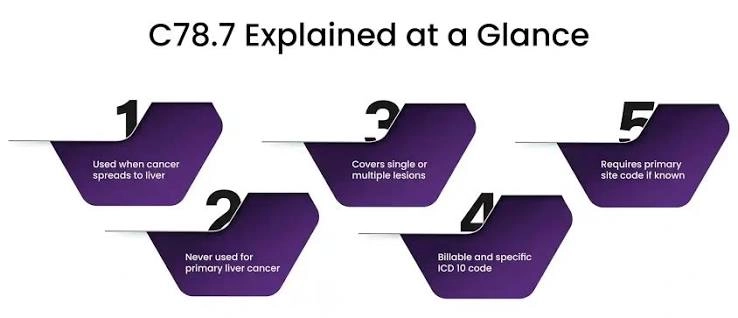
The cornerstone of coding metastatic liver cancer ICD-10 scenarios is C78.7, officially described as "Secondary malignant neoplasm of liver and intrahepatic bile duct." This specific, billable code captures all cases where cancer has spread to the liver from a primary site elsewhere in the body.
When to Assign C78.7
You should use C78.7 whenever documentation indicates:
-
"Metastatic liver cancer ICD-10" or "liver metastases"
-
"Mets to liver" from another primary cancer
-
"Hepatic metastases" or "secondary liver tumor"
-
"Spread to liver" or "liver secondaries"
-
Imaging or pathology confirming secondary malignant involvement of the liver
The C78.7 code requires no additional characters or subcategories. Whether your patient has one metastatic lesion or multiple lesions throughout the liver, you still report C78.7 once per encounter. This code encompasses all secondary cancerous involvement of hepatic tissue, including metastases to the liver parenchyma and intrahepatic bile ducts.
Understanding What C78.7 Does and Doesn't Tell You
C78.7 tells you the liver contains metastatic disease, but it doesn't specify where that cancer originated. That's why you must always look for and code the primary cancer site separately. The complete diagnosis picture requires both the secondary liver cancer ICD-10 code (C78.7) and the primary malignancy code.
Common Primary Sites That Metastasize to the Liver
Recognizing which cancers frequently spread to the liver helps you identify coding scenarios quickly:
-
Colorectal cancer (the most common source of liver metastases)
-
Pancreatic cancer
-
Breast cancer
-
Lung cancer
-
Gastric (stomach) cancer
-
Melanoma
-
Neuroendocrine tumors
-
Esophageal cancer
When any of these primary cancers spread to the liver, C78.7 captures that secondary liver involvement.
Essential Related Codes for Metastatic Liver Cancer ICD-10
While C78.7 is your primary tool for coding secondary liver cancer ICD-10, several other codes come into play depending on the clinical scenario.
Primary Liver Cancer Codes (C22.x Series)
Never confuse these with metastatic disease codes:
-
C22.0: Liver cell carcinoma (hepatocellular carcinoma)
-
C22.1: Intrahepatic bile duct carcinoma
-
C22.2: Hepatoblastoma
-
C22.3: Angiosarcoma of liver
-
C22.4: Other sarcomas of liver
-
C22.7: Other specified carcinomas of liver
-
C22.8: Malignant neoplasm of liver, primary, unspecified as to type
-
C22.9: Malignant neoplasm of liver, not specified as primary or secondary
C22.9: The Unspecified Neoplasm of Liver Code
Code C22.9 deserves special attention because it's frequently misused. This code represents an unspecified liver cancer when documentation states "liver cancer" or "malignant tumor of liver" without clarifying whether it's primary or secondary.
Use C22.9 sparingly. Your first action should always be querying the provider for clarification. However, if no additional information is available and you genuinely cannot determine whether the liver malignancy is primary or secondary, C22.9 becomes your fallback option.
Critical note: Never use C22.9 if you know the liver involvement is secondary. In that case, always assign C78.7. Similarly, don't use C22.9 for clearly documented primary hepatocellular carcinoma; assign the specific C22.0 instead.
Metastatic Hepatocellular Carcinoma ICD-10
The phrase "metastatic hepatocellular carcinoma ICD-10" confuses many new coders. Here's the clarification that will save you from coding errors:
Hepatocellular carcinoma (HCC) is a primary liver cancer. When documentation describes it as "metastatic," this typically means the HCC has spread from the liver to other organs, not that cancer has spread to the liver.
For metastatic hepatocellular carcinoma ICD-10 coding:
-
Assign C22.0 for the primary hepatocellular carcinoma in the liver
-
Add secondary malignancy codes for wherever it has spread (C78.00 for lung metastasis, C79.51 for bone metastasis, etc.)
-
Do not use C78.7 in this scenario because the liver is the primary site, not a secondary site
C80.1: Unknown Primary Cancer Code
When patients present with confirmed liver metastases but the primary cancer source cannot be identified, you'll use C80.1 (Malignant [primary] neoplasm, unspecified) alongside C78.7. This combination indicates "cancer of unknown primary" with liver involvement.
For example, if a biopsy confirms metastatic carcinoma in the liver but extensive workup hasn't revealed the origin:
-
C78.7: Secondary malignant neoplasm of liver
-
C80.1: Malignant neoplasm, unspecified (unknown primary)
This pairing accurately reflects liver metastases from an undetermined source. If the primary is later identified, update subsequent encounters with the specific primary cancer code instead of C80.1.
Personal History of Malignancy (Z85.x Series)
When a patient's primary malignancy has been completely treated or excised but metastatic disease remains in the liver, you'll use a personal history code rather than coding the primary as active disease.
For instance, if a patient had colon cancer resected two years ago (with no evidence of disease at the primary site) and now presents with new liver metastases:
-
C78.7: Secondary malignant neoplasm of liver (active disease)
-
Z85.038: Personal history of other malignant neoplasm of large intestine (primary is historical)
This approach follows ICD-10 guidelines stating that once a primary neoplasm is eradicated and not under active treatment, any remaining metastasis gets coded as secondary malignant neoplasm with the primary coded to personal history.
Secondary Malignancies at Other Sites
When patients have metastases to multiple sites beyond the liver, code each secondary site:
-
C78.00: Secondary malignant neoplasm of lung (add 5th character for laterality if documented)
-
C79.51: Secondary malignant neoplasm of bone
-
C79.31: Secondary malignant neoplasm of brain
-
C78.6: Secondary malignant neoplasm of retroperitoneum and peritoneum
-
C78.89: Secondary malignant neoplasm of other digestive organs
Each distinct secondary site receives its own code to fully capture the extent of metastatic disease.
Sequencing Guidelines: Getting the Order Right
One of the most challenging aspects of coding liver mets ICD-10 scenarios is determining the correct sequence of diagnosis codes. ICD-10-CM guidelines provide clear direction, but applying them in real-world scenarios requires understanding the logic behind the rules.
The Golden Rule: Treatment Focus Determines Principal Diagnosis
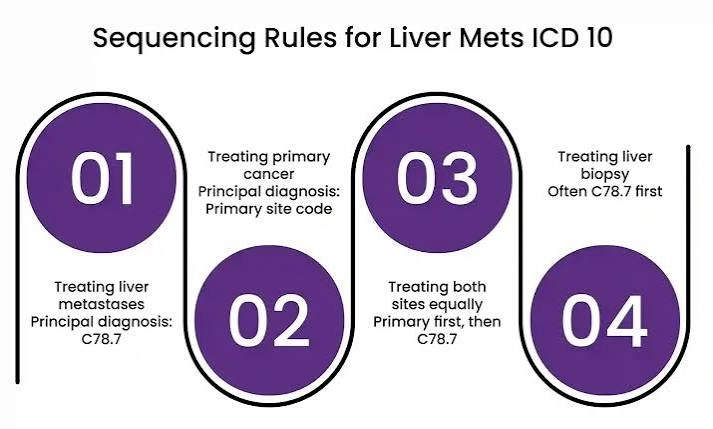
The malignancy being treated during the encounter should be listed as the principal (first-listed) diagnosis. This principle guides all your sequencing decisions.
Scenario 1: Treatment Directed at the Liver Metastases
When the encounter focuses on treating the secondary liver cancer ICD-10 (the metastasis), C78.7 should be your principal diagnosis, even if the primary cancer remains active.
Example: A patient with known breast cancer undergoes radiofrequency ablation of liver metastases. The procedure specifically targets the liver tumors.
Correct coding:
-
Principal: C78.7 (Secondary malignant neoplasm of liver)
-
Secondary: C50.911 (Malignant neoplasm of unspecified site of right female breast, or appropriate specific subcode)
This sequencing reflects that the encounter's primary purpose was treating the liver metastases.
Scenario 2: Treatment Directed at the Primary Cancer
When the encounter focuses on treating the primary malignancy and the liver metastasis is documented but not the treatment focus, sequence the primary cancer first.
Example: A patient with colon cancer and known liver metastases undergoes surgical resection of the primary colon tumor.
Correct coding:
-
Principal: C18.9 (Malignant neoplasm of colon, unspecified, or appropriate specific subcode)
-
Secondary: C78.7 (Secondary malignant neoplasm of liver)
Scenario 3: Treatment Directed Equally at Both Sites
When treatment addresses both the primary and metastatic sites equally (such as systemic chemotherapy treating all cancer sites), coding guidelines typically recommend listing the primary malignancy first, followed by the secondary site codes.
Example: Patient receives FOLFOX chemotherapy for metastatic colorectal cancer affecting both the primary colon site and liver metastases.
Typical coding:
-
Principal: C18.9 (Malignant neoplasm of colon)
-
Secondary: C78.7 (Secondary malignant neoplasm of liver)
Scenario 4: Diagnostic Procedures for Liver Lesions
For encounters solely for diagnostic workup (such as a liver biopsy to confirm suspected metastasis), many coders assign the site being biopsied (C78.7) as the principal diagnosis since the reason for the procedure is investigating the liver lesion.
Example: Patient with history of pancreatic cancer undergoes liver biopsy of newly discovered lesion.
Coding for the biopsy encounter:
-
Principal: C78.7 (Secondary malignant neoplasm of liver, if confirmed by biopsy results)
-
Secondary: C25.9 (Malignant neoplasm of pancreas, unspecified, or appropriate specific subcode)
Documentation Requirements for Accurate Coding
Accurate coding of metastatic liver cancer ICD-10 scenarios depends heavily on clear, specific documentation from providers. As a medical coder, you play a crucial role in ensuring documentation supports proper code assignment.
Essential Documentation Elements
Providers should clearly document:
-
Primary vs. secondary designation: The record should explicitly state whether liver involvement is primary or metastatic
-
Site of origin: For metastatic disease, identify where the cancer originated
-
Confirmation of metastasis: Note imaging findings, biopsy results, or pathology reports confirming metastatic disease
-
Current status: Indicate whether both primary and metastatic sites are active or if the primary has been treated or resolved
-
Treatment intent: Document whether treatment is directed at primary, metastatic, or both sites
Billing and Medical Necessity Considerations
Accurate coding of metastatic liver cancer ICD-10 scenarios directly impacts billing, reimbursement, and demonstrating medical necessity for treatments and procedures.
Linking Diagnoses to Procedures
When submitting claims for procedures related to liver metastases, ensure the diagnosis codes support the medical necessity of the treatment.
Common procedures requiring appropriate C78.7 coding:
-
Liver biopsy (CPT 47000, 47001)
-
Radiofrequency ablation of liver tumor (CPT 47380-47383)
-
Hepatic artery chemoembolization (CPT 37243)
-
Partial hepatectomy or liver resection (CPT 47120-47130)
-
Systemic chemotherapy administration (CPT 96413-96417)
-
Advanced imaging (CT, MRI, PET for staging or surveillance)
-
Stereotactic body radiation therapy (SBRT) for liver lesions
For each of these procedures, linking the correct diagnosis code (C78.7 for liver metastasis plus the primary cancer code) demonstrates that the procedure is medically necessary for the patient's documented condition.
Medical Necessity Examples
Payers evaluate whether treatments are appropriate for the diagnosis codes submitted:
-
C78.7 supports ablation or surgical resection of oligometastatic liver lesions
-
C78.7 plus primary cancer code supports systemic chemotherapy for metastatic disease
-
Multiple metastatic site codes (including C78.7) support palliative care services
-
C78.7 justifies surveillance imaging after treatment for liver metastases
Conversely, if you accidentally code a primary liver cancer (C22.x) when the patient actually has secondary liver cancer ICD-10, the treatment approach may not align with typical management for primary liver tumors, potentially triggering claim reviews or denials.
Common Coding Errors to Avoid
Based on coding audits and common mistakes, here are critical errors to watch out for when coding liver mets ICD-10 scenarios.
Error 1: Using Primary Liver Cancer Codes for Metastatic Disease
Incorrect: Coding C22.0 or C22.9 when documentation clearly states "mets to liver" or "metastatic liver cancer ICD-10"
Correct: Use C78.7 for any cancer that has spread to the liver from elsewhere
Why it matters: This misrepresents the patient's condition, affects statistical reporting of cancer types, and may not support the treatment approach (metastatic disease is managed differently than primary liver cancer).
Error 2: Omitting the Primary Cancer Code
Incorrect: Coding only C78.7 when the patient has an active primary malignancy at another site
Correct: Code both C78.7 and the primary cancer code (such as C18.9 for colon cancer with liver metastases)
Why it matters: Incomplete coding fails to capture the full clinical picture and may result in denial of services that are appropriate for the primary malignancy.
Error 3: Coding Personal History When Primary Cancer Is Still Active
Incorrect: Using Z85.x for the primary site when the primary tumor is still present and under treatment
Correct: Code the primary cancer as current (C-code) if it's still active; only use Z85.x personal history codes when the primary has been completely eradicated
Why it matters: Active cancers should be coded as present, not historical, to accurately reflect ongoing disease burden.
Error 4: Confusing "Metastatic HCC" Coding
Incorrect: Coding C78.7 for "metastatic hepatocellular carcinoma ICD-10" (interpreting it as metastasis to the liver)
Correct: Code C22.0 (primary HCC) plus codes for wherever the HCC has spread (such as C78.00 for lungs, C79.51 for bone)
Why it matters: HCC is a primary liver cancer, so when it's "metastatic," this means it has metastasized from the liver to other sites, not to the liver.
Error 5: Incorrect Sequencing
Incorrect: Always listing the primary cancer first regardless of encounter focus
Correct: Sequence based on treatment focus. If treating the metastatic site, list C78.7 first; if treating the primary, list the primary first
Why it matters: Principal diagnosis sequencing affects DRG assignment in inpatient coding and reflects the actual reason for the encounter.
Error 6: Not Querying Ambiguous Documentation
Incorrect: Guessing or assuming whether "liver cancer" means primary or secondary when documentation is unclear
Correct: Query the provider for clarification of ambiguous terms
Why it matters: Coding based on assumptions rather than documentation can lead to inaccurate claims and potential fraud allegations.
Error 7: Using C22.9 When Disease Type Is Known
Incorrect: Using C22.9 (neoplasm of liver, unspecified as primary or secondary) when documentation clearly indicates metastatic disease or primary HCC
Correct: Use C78.7 for confirmed metastatic disease or specific C22 codes for confirmed primary liver cancer
Why it matters: C22.9 should only be used when the primary vs. secondary nature truly cannot be determined. Using it inappropriately reduces specificity and may not support medical necessity.
Final Words
Whether you're coding liver metastases unspecified scenarios with limited documentation or complex cases involving multiple metastatic sites, following ICD-10-CM guidelines and ensuring clear provider documentation will lead to accurate, compliant coding.
For medical coders, billing specialists, and physicians working with oncology cases, mastering metastatic liver cancer ICD-10 coding is essential to proper claim submission, appropriate reimbursement, and accurate representation of patient care.
Stay current with annual ICD-10-CM updates, participate in ongoing education through organizations like AAPC, and maintain open communication between coders and providers.
ABOUT AUTHOR

Carlos Andrew
As a blog writer with years of experience in the healthcare industry, I have got what it takes to write well-researched content that adds value for the audience. I am a curious individual by nature, driven by passion and I translate that into my writings. I aspire to be among the leading content writers in the world.