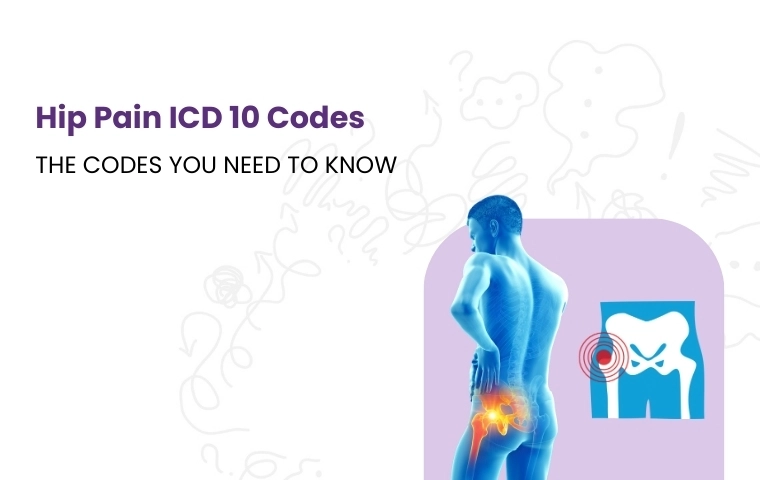
M25.551 - Pain in right hip | M25.552 - Pain in left hip | M25.559 - Pain in unspecified hip (avoid using this) Important: M25.55 is NOT billable. It's a category code only. Always use the specific laterality codes above.
Is M25.55 a Billable Code?
No. The parent code M25.55 cannot be submitted on claims. Only the laterality-specific codes (M25.551, M25.552, M25.559) are billable.
Key Rule: Laterality Is Mandatory
ICD 10 code for hip pain requires you to specify which hip hurts. Document "right hip pain" or "left hip pain" in every section of your note - chief complaint, HPI, exam, and assessment.
For bilateral hip pain: Code BOTH M25.551 AND M25.552. Never use M25.559 for bilateral pain.
ICD 10 Code for Right Hip Pain
M25.551 - Use when:
· Patient has right hip pain
· No specific diagnosis identified yet
· Imaging shows no definitive pathology
· Pain is the primary presenting complaint
Document: "Right hip pain" with pain characteristics, duration, exam findings, and what imaging showed.
ICD 10 Code for Left Hip Pain
M25.552 - Use when:
· Patient has left hip pain
· No underlying cause diagnosed
· Workup incomplete or negative
· Symptom-based visit
Document: "Left hip pain" with specific location (groin vs lateral vs posterior), severity, and functional impact.
ICD 10 Code for Bilateral Hip Pain
Code both: M25.551 + M25.552
Describe each hip separately in your documentation:
· Right hip: [findings]
· Left hip: [findings]
This supports medical necessity for bilateral treatment and prevents denials.
Need help with medical coding and billing? HMS USA LLC specializes in revenue cycle management for healthcare providers. Our expert coders ensure accurate ICD-10 coding that maximizes reimbursement and minimizes denials. Contact HMS USA LLC today to streamline your billing process.
ICD 10 Code for Hip Pain Unspecified
M25.559 - Only use when laterality is genuinely unknown (rare situations like telephone encounters or reviewing old records where patient is unavailable).
Avoid this code. It signals incomplete documentation and increases denial risk.
Chronic Hip Pain ICD 10
For chronic hip pain (3+ months duration):
Primary code: M25.551 or M25.552 (specify laterality)
Add if appropriate: G89.29 (Other chronic pain)
Document for chronic pain coding:
· Duration in months/years
· Failed conservative treatments (PT, NSAIDs, etc.)
· Functional limitations
· Pain frequency and severity
· Impact on daily activities
Sequencing: If the visit is for pain management, code G89.29 first. If it's for the hip condition with pain as a symptom, code M25.55x first.
Acute Hip Pain ICD 10
Critical distinction: Acute traumatic hip pain is coded from Chapter 19 (Injury codes), NOT M25.55x.
Example: Patient falls and injures hip:
· Use: S79.91xA (Unspecified injury of hip, initial encounter)
· NOT: M25.551 (Pain in right hip)
Non-traumatic acute hip pain: Use M25.55x codes as appropriate.
When NOT to Use Hip Pain Codes
Code the underlying condition instead of M25.55x when you identify:
Hip osteoarthritis:
· M16.11 (Right hip OA)
· M16.12 (Left hip OA)
· M16.0 (Bilateral hip OA)
Trochanteric bursitis:
· M70.61 (Right trochanteric bursitis)
· M70.62 (Left trochanteric bursitis)
Labral tear:
· M24.151 (Right hip cartilage disorder)
· M24.152 (Left hip cartilage disorder)
Lumbar radiculopathy (referred pain):
· M54.16 (Radiculopathy, lumbar region)
Rule: If imaging or exam reveals a specific diagnosis, code that diagnosis. Use M25.55x only when the cause remains unclear after workup.
Struggling with denied claims due to coding errors? HMS USA LLC's certified coding specialists prevent costly mistakes and recover lost revenue. Our team stays current with the latest ICD-10 updates to keep your practice compliant. Schedule a consultation to learn how we can optimize your revenue cycle.
Essential Documentation Elements
Include these in every hip pain encounter:
· Laterality: Right, left, or bilateral (stated explicitly)
· Pain description: Location, quality, severity (0-10 scale)
· Duration: When it started, acute vs chronic
· Mechanism: Trauma vs insidious onset
· Exam findings: ROM, special tests (FABER, FADIR), gait
· Imaging results: What you ordered and what it showed
· Prior treatments: What's been tried and the response
Common Documentation Mistakes
Mistake #1: Writing "hip pain" without specifying right or left
Fix: Always include laterality in your assessment
Mistake #2: Coding M25.551 when X-ray shows osteoarthritis
Fix: Code the OA (M16.11), not the symptom
Mistake #3: Using M25.559 for bilateral pain
Fix: Code both M25.551 + M25.552
Mistake #4: Coding pain code for acute trauma
Fix: Use Chapter 19 injury codes (S79.91xA)
Mistake #5: Insufficient chronic pain documentation
Fix: Document duration, failed treatments, functional impact
Quick Decision Tree
Is laterality documented?
· Yes, right hip → M25.551
· Yes, left hip → M25.552
· Both hips → M25.551 + M25.552
· Unknown (rare) → M25.559
Did imaging or workup reveal a specific diagnosis?
· Yes → Code that diagnosis (OA, bursitis, etc.)
· No → Use M25.55x codes
Was there acute trauma?
· Yes → Use Chapter 19 injury code
· No → Use M25.55x codes
Is pain chronic (3+ months) and main focus of visit?
· Yes → Consider adding G89.29
· No → M25.55x alone is sufficient
Coding Examples
Example 1: Simple right hip pain
· Documentation: "Right hip pain x 3 weeks, no trauma, X-ray negative"
· Code: M25.551
Example 2: Hip OA diagnosed
· Documentation: "Right hip pain, X-ray shows advanced OA"
· Code: M16.11 (NOT M25.551)
Example 3: Bilateral pain
· Documentation: "Both hips painful, right worse than left"
· Code: M25.551 + M25.552
Example 4: Trochanteric bursitis
· Documentation: "Left lateral hip pain, tender over greater trochanter"
· Code: M70.62 (NOT M25.552)
Example 5: Chronic refractory pain
· Documentation: "Chronic right hip pain x 18 months, failed PT and NSAIDs"
· Code: G89.29 (primary), M25.551 (secondary)
Related Codes You May Need
· M16.x - Hip osteoarthritis (most common cause)
· M70.61/62 - Trochanteric bursitis
· M54.16 - Lumbar radiculopathy (referred pain)
· M25.651/652 - Hip stiffness
· G89.29 - Chronic pain
· E66.9 - Obesity (risk factor)
· Z96.641/642 - Status post hip replacement
The Bottom Line
Three simple rules for hip pain coding:
1. Always specify laterality: Right, left, or both (never unspecified)
2. Code the diagnosis, not the symptom: If you identify OA or bursitis, code that
3. Document thoroughly: Laterality + pain details + exam + imaging = clean claims
Master these basics and your hip pain claims will process without delays or denials.
Ready to eliminate coding headaches and boost your revenue? HMS USA LLC offers comprehensive medical billing and coding services tailored to your specialty. Our team handles everything from claim submission to denial management, so you can focus on patient care. Contact us now for a free practice assessment and see how much revenue you're leaving on the table.
Keyword Quick Reference
· Primary keyword: hip pain icd 10
· ICD 10 code for hip pain: M25.551, M25.552, M25.559
· ICD 10 code for bilateral hip pain: M25.551 + M25.552
· ICD 10 code for left hip pain: M25.552
· ICD 10 code for right hip pain: M25.551
· ICD 10 code for hip pain unspecified: M25.559 (avoid)
· Chronic hip pain icd 10: M25.55x + G89.29 if appropriate
· Acute hip pain icd 10: Trauma = S79.91xA; Non-trauma = M25.55x
· Is m25.55 a billable code: No, only M25.551, M25.552, M25.559 are billable
ABOUT AUTHOR

Temba Altman
As a blog writer with years of experience in the healthcare industry, I have got what it takes to write well-researched content that adds value for the audience. I am a curious individual by nature, driven by passion and I translate that into my writings. I aspire to be among the leading content writers in the world.