An abnormal electrocardiogram (EKG) is often the first indicator of a potential cardiac event. In medical billing and coding, capturing that finding accurately can be the difference between a clean claim and a denied one. For providers, understanding the right use of the ICD-10 code for abnormal EKG is essential, especially when the abnormality isn't tied to a confirmed diagnosis.
This guide breaks down the use of R94.31 diagnosis code, walks through related coding scenarios including in pregnancy and clarifies the link between ICD-10 and related CPT codes. If you’ve ever wondered, Is R94.31 a billable ICD-10 code? or searched for the ICD-10 code for abnormal EKG unspecified, this resource will give you every clinical and billing insight you need.
What Is R94.31 and When Should You Use It?
R94.31 refers to an abnormal result of an EKG. It is assigned when the electrocardiogram shows findings outside the standard range, yet a definitive diagnosis has not been determined.
Key Highlights:
-
R94.31 is a billable ICD-10 code that reflects non-specific but clinically relevant EKG changes.
-
It is used only when no confirmed cardiac condition is identified, and the abnormality itself is the primary finding.
-
This code falls under the ICD-10 Chapter 18: Signs, symptoms, and abnormal clinical findings.
A few examples of findings where R94.31 is commonly used:
-
Non-specific ST or T-wave changes
-
Prolonged QT interval without a formal long QT syndrome diagnosis
-
Borderline EKG interpretations
-
PVCs or PACs noted without a defined arrhythmia diagnosis
If the provider later confirms atrial fibrillation, ischemic changes, or another definitive cardiac condition, that diagnosis replaces R94.31.
Do You Need Another Code for ICD-10 Abnormal EKG Unspecified
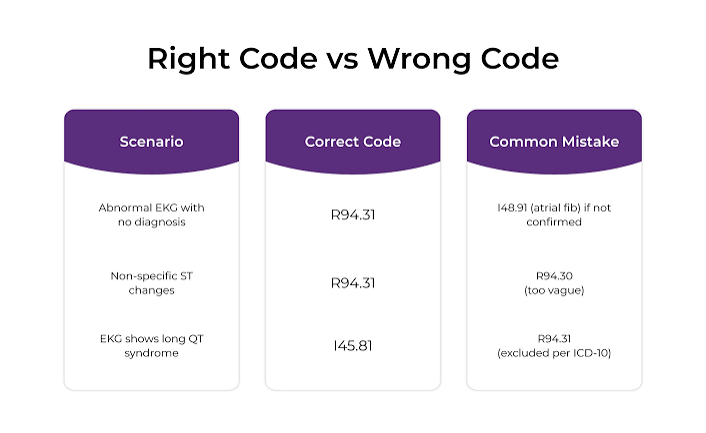
There is no separate ICD-10 code for abnormal EKG unspecified. That scenario is fully covered by R94.31.
However, coders should avoid using R94.30 (Abnormal cardiovascular study, unspecified) when the test in question is an EKG. In such cases, R94.31 is the more precise and appropriate choice.
Related ICD-10 Codes to Keep in Mind:
-
R94.30 – Use only if the test type is not documented.
-
R94.39 – For abnormal results on other cardiovascular function studies (e.g., stress tests).
-
I45.81 – If long QT syndrome is confirmed (do not use R94.31 here due to an Excludes1 note).
How to code Abnormal EKG in Pregnancy
If an abnormal EKG is found during pregnancy, a two-code combination is usually required:
-
O99.41X – Diseases of the circulatory system complicating pregnancy (choose trimester-specific variation).
-
R94.31 – To indicate the actual finding of the abnormal EKG.
Example:
For a third-trimester patient presenting with palpitations and an EKG that shows non-specific T-wave changes:
-
O99.413 – Circulatory system disease complicating pregnancy, third trimester
-
R94.31 – Abnormal EKG
If the abnormality is considered incidental and not affecting patient care, providers must clearly document that to avoid unnecessary complication coding. However, ICD-10 guidelines default to treating abnormal findings during pregnancy as pregnancy-related unless otherwise specified.
EKG CPT Codes That Pair with the ICD-10 Code for Abnormal EKG
Here are the most common CPT codes used for electrocardiograms that may be linked to R94.31:
|
CPT Code |
Description |
|
93000 |
EKG with 12 leads, including interpretation and report |
|
93005 |
EKG tracing only |
|
93010 |
Interpretation and report only |
|
93040–93042 |
Rhythm strips (1–3 leads) with variations for report/tracing only |
When the abnormal EKG is the main finding, R94.31 can be listed as the primary diagnosis. In other scenarios, such as chest pain evaluations or preoperative testing, R94.31 may serve as a secondary diagnosis alongside R07.9 (chest pain) or Z01.810 (preoperative cardiovascular exam).
What Providers Should Know About Medicare Rules for R94.31 Diagnosis Code
Medicare recognizes R94.31 as a valid diagnosis to justify diagnostic cardiac procedures. It is included in clinical coverage documentation across multiple MACs (Medicare Administrative Contractors) for services like:
-
Stress testing
-
Holter monitoring
-
Cardiology consultations
However, as with all “signs and symptoms” codes, payers expect it to be supported by physician documentation. R94.31 cannot be used to justify long-term management or repeated services without evidence of evaluation or a resulting diagnosis.
Clinical Documentation and Billing Tips
To ensure proper claim reimbursement, your documentation must:
-
Explicitly state that the EKG result was abnormal
-
Describe the nature of the abnormality (e.g., “nonspecific T-wave inversions”)
-
Avoid assuming or coding a condition not yet diagnosed
-
Clearly reflect if further workup or specialist referral is being planned
If the EKG is done in response to symptoms (like syncope or palpitations), document those symptoms clearly. If it's part of routine screening, state whether the result changes management.
Pro Tip:
R94.31 can be the primary diagnosis only if it is the reason for the visit or follow-up. It should not be the primary code if a more specific cardiac diagnosis is confirmed during the encounter.
Final Thoughts
The ICD-10 code for abnormal EKG (R94.31) may seem like a simple diagnostic placeholder, but in medical billing, it holds significant weight. Whether you're dealing with an outpatient evaluation, a pregnancy complication, or a pre-op clearance, R94.31 helps justify testing, referral, and clinical decision-making.
It is billable. It is specific. And when documented accurately, it protects your revenue stream while reflecting high-quality care.
ABOUT AUTHOR

Carlos Andrew
As a blog writer with years of experience in the healthcare industry, I have got what it takes to write well-researched content that adds value for the audience. I am a curious individual by nature, driven by passion and I translate that into my writings. I aspire to be among the leading content writers in the world.