Drug billing did not change through a dramatic overhaul.It changed through reporting precision.The introduction of the jz modifier in medical billing marked a shift where Medicare stopped relying on implied assumptions about drug utilization and moved toward explicit reporting of how single dose vial drugs are actually used.
For many practices, this did not feel like a major update at first.But over time, the absence of proper JZ or JW reporting began to create claim inconsistencies, denial patterns, and audit attention.
The issue was never awareness of drugs.It was visibility into utilization.
If your organization is still refining drug billing accuracy or aligning clinical documentation with claims, our medical coding services support specialty practices handling high complexity infusion workflows.
How Drug Utilization Reporting Actually Works in Practice
Every single dose vial introduces a simple operational reality.
A drug is prepared. A dose is administered. And one of two outcomes occurs:
• The entire vial is used
• A portion of the vial remains unused
This is where billing accuracy becomes critical. Because Medicare does not evaluate intent. It evaluates documented utilization. The jz modifier in medical billing exists to explicitly confirm full vial usage with no discarded drug
JW and JZ Are Two Sides of the Same Billing Event
Understanding drug waste reporting requires understanding both modifiers together.
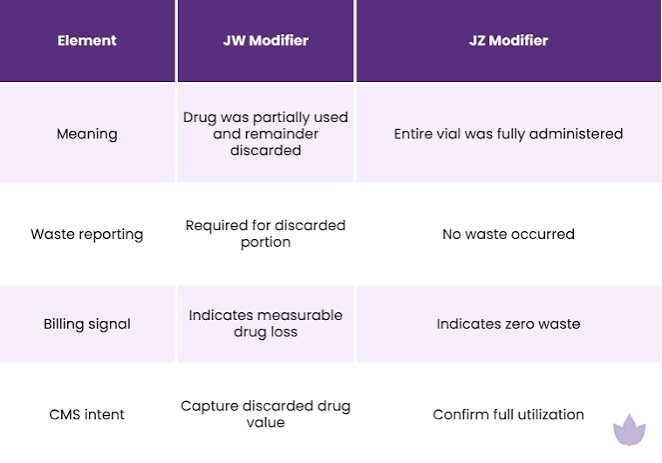
The difference between JZ and JW modifier is based on whether any drug remains after administration.
-
JW indicates that a portion of the vial was discarded after partial use.
-
JZ indicates that the entire vial was fully administered with no waste.
Before 2023, full use was implied when JW was not present.
That assumption no longer exists. Now, reporting must be explicit.
What JZ Modifier Actually Means in Medical Billing Systems
The JZ modifier description is defined as zero drug amount discarded or fully used.
The JZ modifier is a Medicare reporting indicator that confirms complete utilization of a single dose vial.
It is used to ensure that drug administration records match billing claims with full transparency on vial usage
When CMS Introduced JZ Modifier Requirements
The JZ modifier became effective on January 1, 2023. Medicare started requiring a JZ modifier on January 1, 2023 for all applicable single dose vial drug claims under Part B.
This replaced the previous implicit reporting model where absence of JW was treated as full utilization.
What Type of Modifier JZ Is in Billing Classification
The JZ modifier is an informational billing modifier.It does not adjust reimbursement rates.
Instead, it validates drug utilization reporting so Medicare can verify whether waste occurred or not.
Where Billing Breakdowns Actually Occur
Most revenue leakage does not come from misunderstanding what JZ is.
It comes from execution gaps between clinical documentation and billing submission.
Common breakdown points include:
• Vial usage not documented clearly at administration level
• Nursing records not aligned with billing logic
• JW or JZ assigned without consistent validation
• Claims submitted without correct modifier attachment
These issues rarely appear immediately.
They accumulate gradually through operational inconsistency.
For structured evaluation of these gaps, our medical billing and coding audit services help identify where breakdowns begin.
Billing Workflow That Determines JZ Accuracy
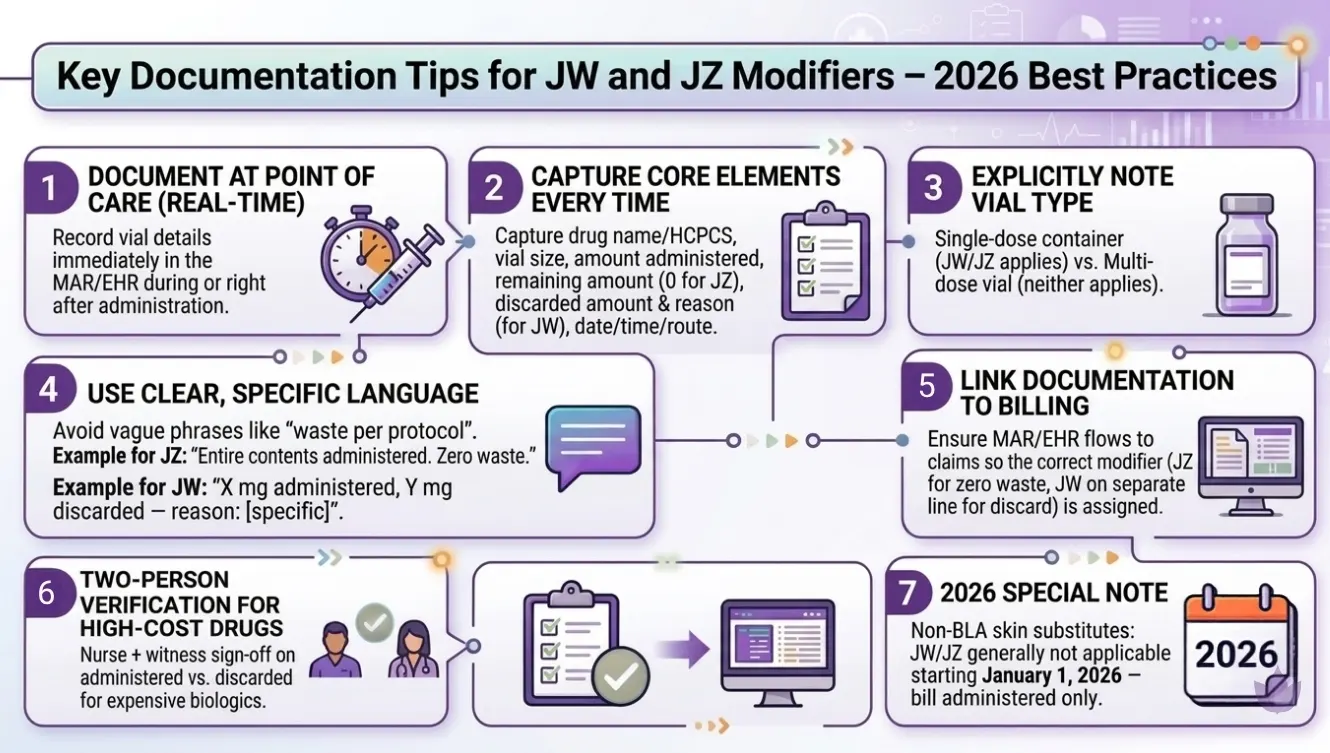
JZ accuracy is not a coding decision.It is a workflow outcome.A correct system typically follows this structure:
• Drug is prepared and administered at chairside
• Vial type and usage are documented at the point of care
• Remaining volume is recorded clearly
• Billing system receives structured utilization data
• Modifier is assigned based on actual vial outcome
Zero waste results in JZ assignment. Any discard results in JW reporting.
If this workflow is inconsistent, downstream claims will reflect that inconsistency.
JZ Modifier Example in Real Billing Context
A patient receives a 250 mg infusion from a single dose vial.
The full dosage is administered.
No drug remains after completion.
The claim is submitted with:
• HCPCS drug code
• Full unit reporting
• JZ modifier
No JW line is submitted because no waste occurred.
Drug Categories Where JZ Reporting Commonly Applies
There is no fixed published list of drugs requiring JZ modifier. Application depends on whether a drug is billed from a single dose vial.
Common categories include:
• Oncology infusion medications
• Monoclonal antibody therapies
• Immunotherapy agents
• Chemotherapy injectables
• IV immunoglobulin products
• Specialty biologics
• Ophthalmology injection therapies
The deciding factor is not drug name. It is vial structure and billing pathway.
J3301 and JZ Modifier Application Logic
Whether J3301 requires a JZ modifier depends on formulation.If triamcinolone acetonide is administered from a single dose vial, JW or JZ rules apply. If it is supplied in multi dose format, JZ does not apply.
Medicare Versus Commercial Insurance Behavior
The JZ modifier originates from Medicare Part B requirements.
However, Medicaid programs and some commercial payers have adopted similar reporting logic.
JZ Modifier For Commercial Insurance
Commercial payer adoption is inconsistent.Some insurers align closely with Medicare waste reporting rules.Others do not enforce JZ as a mandatory claim field.
This is why many practices standardize JW and JZ usage across all payer types for consistency.
For facility billing alignment context, see revenue code 0636 guide.
What Insurances Require Modifier JZ
Medicare Part B requires JZ for eligible claims.Some Medicaid programs require it based on state policy.Commercial payer requirements vary by contract structure and region.
Where Financial Risk Actually Appears
JZ related billing issues do not usually show up as immediate failures.
They show up as patterns.
• Claim inconsistencies across similar encounters
• Missing documentation alignment between clinical and billing teams
• Gradual denial rate increases on drug claims
• Audit focus on utilization reporting accuracy
When these patterns appear, the issue is no longer isolated. It becomes systemic.
For structured correction, our orthopedic billing services support specialty environments where injection based billing overlaps with infusion workflows.
Final Perspective on JZ Modifier in Medical Billing
The JZ modifier in medical billing is not complicated in definition.The complexity lies in execution.It forces alignment between:
• clinical documentation
• pharmacy preparation
• billing logic
• payer expectations
When these systems operate in sync, claims remain clean and reimbursement remains stable.When they do not, errors accumulate silently until they surface as denials or audits.The difference is not knowledge. It is operational discipline.
ABOUT AUTHOR

Temba Altman
As a blog writer with years of experience in the healthcare industry, I have got what it takes to write well-researched content that adds value for the audience. I am a curious individual by nature, driven by passion and I translate that into my writings. I aspire to be among the leading content writers in the world.