
If you logged into your CAQH account recently, you may have noticed something unfamiliar. The login works the same way it always has. Your profile is exactly where you left it.
But the name on the page has changed, and if you searched for answers, you probably found a mix of outdated ProView instructions, half explanations, and articles that never mention the rebrand at all.
This guide clears that up. It explains what CAQH credentialing actually is, what changed after the 2026 rebrand, and what stayed exactly the same.
Then it walks through the complete process, from your first login to your next reattestation, the way a credentialing specialist would walk a new client through it.
What Is CAQH?
CAQH stands for the Council for Affordable Quality Healthcare. It is the organization behind the credentialing database that most commercial payers, Medicare Advantage plans, and Medicaid managed care organizations in the United States rely on to verify who you are, what you are licensed to do, and whether you carry adequate malpractice coverage.
The idea behind it has stayed the same since the platform launched in 2002. Instead of filling out a separate paper application for every insurance company you want to join, you build one profile, upload your supporting documents once, and authorize each payer to pull directly from that file.
The database now holds more than 4.8 million provider records and feeds credentialing and eligibility data covering roughly three out of every four insured Americans. Physicians, nurse practitioners, physician assistants, behavioral health clinicians, dentists, and allied health providers all use the same core system. If you plan to bill any commercial payer, Medicare, or most state Medicaid programs, a current CAQH profile is not optional. It is the starting line.
CAQH ProView vs. the CAQH Provider Data Portal vs. DataSpring
This is where most of the confusion comes from, so it is worth settling before anything else. You will run into three names, and they do not refer to three different systems.
|
Name |
What it actually is |
|
CAQH ProView |
The former, and now retired, name of the provider credentialing portal. If an article or a colleague still calls it this, they are describing the same system by its old name. |
|
CAQH Provider Data Portal |
The current name of the actual portal where you log in, build your profile, upload documents, and authorize payers. Same login, same web address, same data as ProView. |
|
DataSpring, powered by CAQH |
The new name of the parent organization itself, announced on June 8, 2026. This is a corporate rebrand, not a new piece of software. The Provider Data Portal operates under the DataSpring name. |
In short, your login at proview.caqh.org still works, your CAQH ID has not changed, and your existing documents and attestation history carried over automatically. Nothing about your day to day workflow was affected by the name change.
Why CAQH Rebranded
Two separate events led to the name on your portal changing, and it helps to understand both so you know what you are actually looking at.
In January 2026, CAQH converted from a not for profit alliance into a for profit company. Ownership passed to twelve shareholder organizations affiliated with the country's largest health plans, including UnitedHealth Group, Centene, Aetna, Elevance Health, Cigna, and Humana, along with a coalition of Blue Cross Blue Shield licensees. Five months later, on June 8, 2026, the organization introduced its new public identity as DataSpring, powered by CAQH, at the AHIP conference.
What this means for your practice:
Leadership has stated the rebrand reflects a broader positioning shift, not a platform migration. The same records, the same portal, and the same 120 day attestation cycle that governed CAQH ProView still govern the CAQH Provider Data Portal today. Your action items have not changed. Your vocabulary has.
What Changed After the Rebrand, and What Did Not
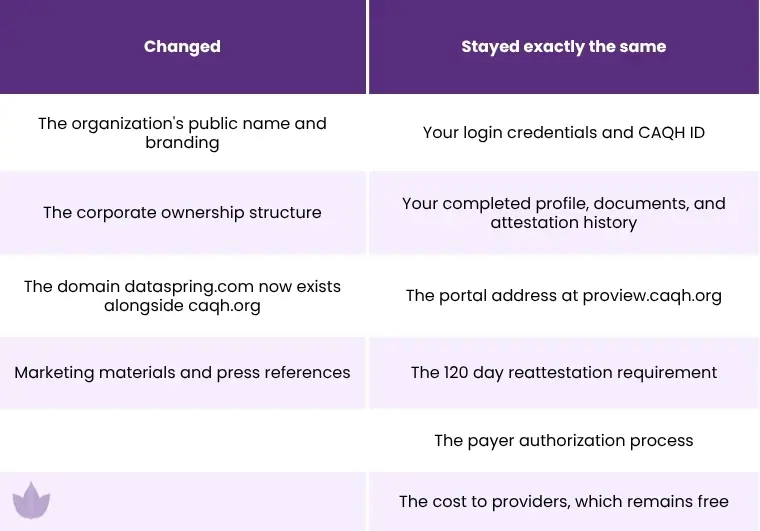
Why CAQH Credentialing Matters for Your Practice
A complete, current CAQH profile is not paperwork for its own sake. It is the mechanism that determines whether a payer will move your application forward at all.
An incomplete or stale profile does not just slow down one insurance company. It stalls every payer you are trying to join at once, because they are all pulling from the same file.
The providers who get through credentialing fastest are the ones who treat their CAQH profile as a living document rather than a one time task.
That single shift, building it right the first time and maintaining it on a schedule, is usually the difference between a provider seeing patients under a new contract in ten weeks versus five months.
It is also where most of our medical credentialing services work happens: keeping a provider's data accurate, complete, and attested so payer applications never sit waiting on missing information.
How CAQH Credentialing Works
The workflow has four moving parts. Understanding them up front makes every later section easier to follow.
You build one profile. Personal information, education, licensure, work history, and malpractice coverage all live in a single record tied to your CAQH ID.
You authorize specific payers. A completed profile is invisible to insurance companies until you grant each one permission to view it.
You attest to accuracy. Every 120 days, you confirm the information on file is still correct, even if nothing changed.
Payers verify independently. CAQH speeds up data collection, but each payer's own credentialing committee still reviews and approves your file before you are in network
Step by Step: The CAQH Registration Process
Most providers are invited to register by a health plan or a hospital, but you can also self-register directly.
Get your NPI ready. You will need both your Type 1 individual NPI and, if applicable, your organization's Type 2 NPI before you begin.
Register for a CAQH ID. If a payer has not already generated one for you, self-register through the Provider Data Portal to receive your unique identifier.
Complete each profile section. Personal information, professional IDs, education and training, specialties, practice locations, and hospital affiliations, working through the roughly twenty sections in order.
Upload supporting documents. Licenses first, so they can be verified automatically, followed by malpractice coverage, DEA certification if applicable, and employment history.
Answer the disclosure questions. Malpractice history, license actions, and any past sanctions. Every answer here gets independently verified, so accuracy matters more than a clean-looking file.
Authorize your payers. Grant access individually to every health plan you intend to enroll with. An unauthorized payer simply cannot see your data, no matter how complete it is.
Attest and submit. Review the full profile and electronically confirm it is accurate. Your data is not visible to any payer until this step is done.
Documents You Will Need
Gather these before you start. Providers who assemble everything first typically finish their profile in a single sitting instead of stretching it across several partial logins.
-
Current state license for every state where you practice
-
DEA certificate, and state Controlled Dangerous Substance certificate if applicable
-
Board certification documentation, or proof of board eligibility
-
Malpractice insurance face sheet showing your name, policy dates, and coverage limits
-
Curriculum vitae or resume with complete work and education history
-
Signed and dated IRS Form W-9
-
Government-issued photo ID
-
Educational diplomas and, for foreign medical graduates, an ECFMG certificate
-
Written explanations for any employment gap longer than 30 days
How to Complete Your Provider Profile Without Getting Stuck
A handful of sections cause nearly every delay we see. Give these extra attention.
Work history
CAQH expects continuous work history, typically going back five years or more, accounted for month by month. A one-month gap with no explanation is enough to trigger a payer follow-up request. Note locum tenens work, research positions, teaching appointments, and parental or medical leave rather than leaving blank periods.
Malpractice and disclosure
List your current carrier, policy number, coverage limits, and dates exactly as they appear on your face sheet. If you have ever had a malpractice claim, license action, or disciplinary matter, disclose it fully with a written narrative. Payers cross-check these answers independently, and an inconsistency reads as far worse than the underlying incident usually is.
Identity and taxonomy accuracy
Your name in the Provider Data Portal must match your NPI registry record exactly, including suffixes. Behavioral health and specialty providers should also confirm their taxonomy codes reflect their actual scope of practice; a mismatched code is a common, avoidable reason applications bounce back. This is a frequent snag for the psychiatry and behavioral health practices we work with, since payers scrutinize behavioral health credentialing closely.
How to Authorize Health Plans
A finished profile does nothing on its own. Authorization is a separate, deliberate step for each payer.
-
Open the payer list inside your Provider Data Portal account and search for each plan you want to enroll with.
-
Grant access individually. Every payer requires its own authorization, even ones affiliated with a plan you already authorized.
-
Confirm the request went through before assuming the payer can see your file. A missed authorization is one of the most common reasons an application appears "stuck" when the profile itself is complete.
-
Recheck authorizations whenever you add a new payer relationship or join a new group practice.
How Attestation Works, and How Often You Need to Do It
Attestation is your electronic confirmation that everything in your profile is still accurate. It is required every 120 days, whether or not anything has changed. If your attestation lapses, your profile effectively goes dark to every payer relying on it at once, which can stall applications that were otherwise moving smoothly.
Set a recurring reminder. The 120 day cycle is the single most common reason a fully accurate profile still causes a delay. Most practices that miss it simply forgot, not because the underlying data was wrong.
Separate from attestation, most payers also require formal recredentialing roughly every 36 months, pulling a fresh snapshot of your CAQH data to confirm you still meet their standards.
Common CAQH Credentialing Mistakes
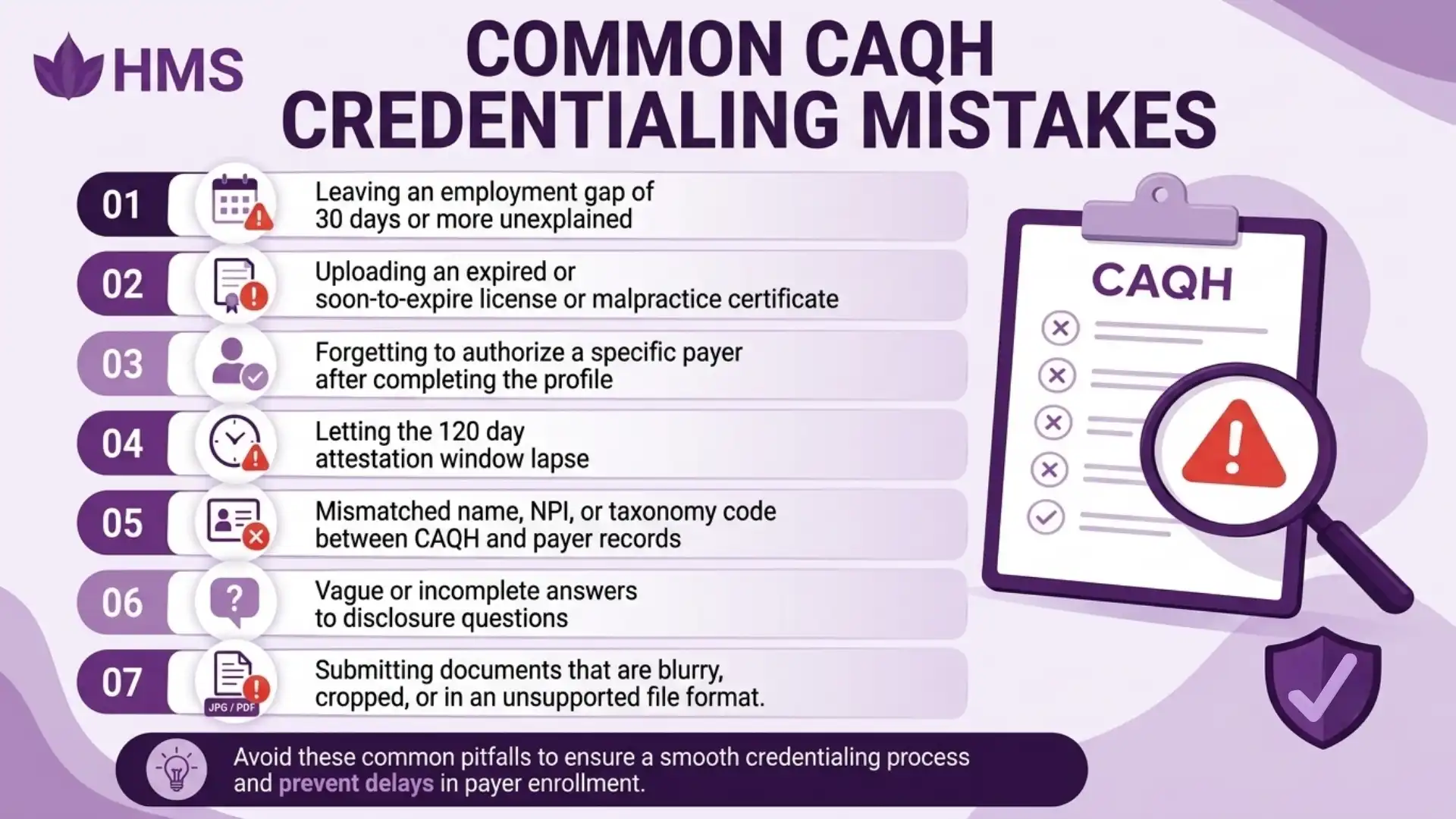
Most of these are simple to prevent, and none of them require guesswork. Our teams build profile audits into standard audit services precisely to catch this kind of issue before a payer does.
Common Reasons Credentialing Gets Delayed
Beyond profile errors, a handful of structural issues slow providers down again and again.
-
Treating CAQH as a one-time task instead of an ongoing maintenance item
-
Assuming a completed profile means every payer can automatically see it
-
No internal owner tracking attestation dates across multiple providers in a group
-
Waiting for a payer to flag a problem instead of auditing proactively
-
Missing supplemental payer-specific requirements that CAQH alone does not cover
How CAQH Affects Insurance Enrollment and Your Revenue Cycle
Credentialing delays are not just an administrative headache. They are a direct hit to cash flow. A provider who cannot bill a payer because their CAQH authorization was never confirmed is a provider who is seeing patients for free until the paperwork catches up. That gap shows up squarely in your revenue cycle KPIs, particularly days in accounts receivable and first-pass claim rate.
It also affects reimbursement accuracy once you are enrolled. Payers set contracted rates and allowed amounts based on the credentialing data on file, so an inconsistency between your CAQH profile and your payer contract can quietly cost you money on every claim, not just delay the first one.
This is why we treat credentialing and medical billing as one connected process rather than two separate departments. A provider enrollment issue eventually becomes a billing issue, and catching it early is far cheaper than untangling it after claims start denying.
Which Health Plans Use CAQH
More than 1,000 health plans and healthcare organizations pull from the CAQH database, covering roughly three out of every four insured Americans. That includes the major national commercial carriers, most Medicare Advantage plans, a growing share of state Medicaid managed care programs, and many IPAs and ACOs. Coverage varies by state and by plan, so it is still worth confirming whether a specific payer in your market credentials through CAQH before you build your enrollment timeline around it.
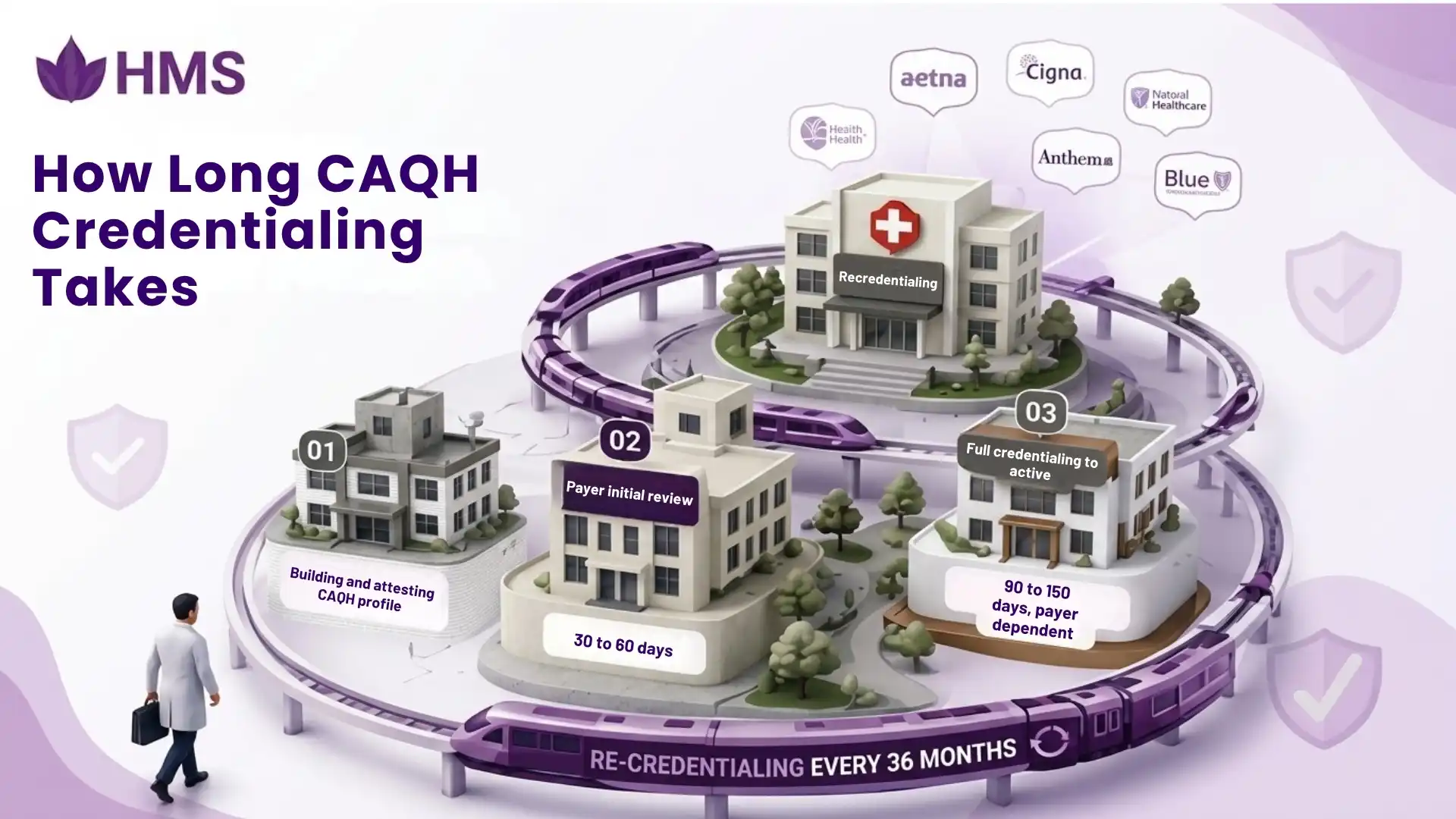
An incomplete profile, a missed attestation, or an unauthorized payer can add weeks to any stage above. This is the single biggest variable providers control directly.
Best Practices for Faster Approval
-
Gather every required document before you open the portal, not while you are in it
-
Attest on a calendar reminder well before the 120 day deadline, not on the deadline
-
Authorize new payers the same day you sign a contract with them
-
Review your profile quarterly even if nothing has changed, since expired items surface silently
-
Keep a standing folder of current licenses, DEA certification, and malpractice documents so renewals upload immediately
-
Assign one person, internally or through your credentialing partner, to own attestation tracking across every provider in your group
CAQH Security and Provider Data Management
Your CAQH profile includes sensitive information: your SSN, malpractice history, and disclosure answers among it. The Provider Data Portal uses encrypted storage and role-based access controls, and only payers you explicitly authorize can view your record.
The 2026 ownership change moved the organization to a for-profit structure held by health plan shareholders, but the operational security model and access permissions for provider data have not changed as a result.
If you have concerns about how your data is governed, DataSpring's public documentation is the most current source, since this is an area worth monitoring as the platform evolves.
FAQ! Need Help?
No. The portal itself is now called the CAQH Provider Data Portal. Separately, the parent organization rebranded as DataSpring, powered by CAQH, in June 2026. Your login and data did not change.
No. Your existing CAQH ID, login credentials, profile, documents, and attestation history all carried over automatically. There is nothing to re-create.
Every 120 days, regardless of whether any information has changed. Missing this window can make your profile invisible to payers until you attest again.
Yes. The Provider Data Portal remains free to use for providers. No changes to that model were announced alongside the rebrand.
Attestation is your 120 day confirmation that your existing profile data is accurate. Recredentialing is a more thorough review most payers conduct roughly every 36 months to confirm you still meet their network standards.
ABOUT AUTHOR

Tom alsvin
As a blog writer with years of experience in the healthcare industry, I have got what it takes to write well-researched content that adds value for the audience. I am a curious individual by nature, driven by passion and I translate that into my writings. I aspire to be among the leading content writers in the world.