If you were hurt in a Florida car accident, you have 14 days to receive qualifying medical care for your Personal Injury Protection benefits to apply. Here is what that means in practice.
-
You must receive qualifying initial services and care within 14 days of the accident date.
-
Only certain licensed providers can deliver that initial care.
-
PIP can pay up to 10,000 dollars in medical and disability benefits, but only if a qualifying provider determines you had an emergency medical condition. Otherwise coverage is limited to 2,500 dollars.
-
As of August 2026, the 14 day requirement is still active law in Florida. A proposal to repeal PIP did not pass.
Here is the full explanation, along with what it means if you missed the deadline, what happens after your first visit, and what medical providers and billing teams should know about the claim once treatment begins.
Why the 14 Day Rule Matters After a Florida Car Accident
Florida is a no fault state. That means your own PIP coverage is designed to pay your medical bills and part of your lost income after an accident, regardless of who caused the crash.
But that coverage comes with a condition. Under Florida law, PIP medical benefits are only payable if you receive qualifying initial services and care within 14 days of the accident. Miss that window, and the insurer may have grounds to deny the medical benefit portion of your claim.
Florida's Department of Financial Services describes PIP as generally covering 80 percent of reasonable and necessary medical expenses, 60 percent of lost income, and a 5,000 dollar death benefit, subject to the policy's overall limits. The 14 day requirement sits directly inside the statute that governs those medical benefits, which is why it carries so much weight.
What Must Happen Within the 14 Days
What Does Initial Services and Care Actually Mean
Booking an appointment is not the same as receiving qualifying care. The law requires that actual initial services and care take place within the 14 day window, not simply that a visit gets scheduled.
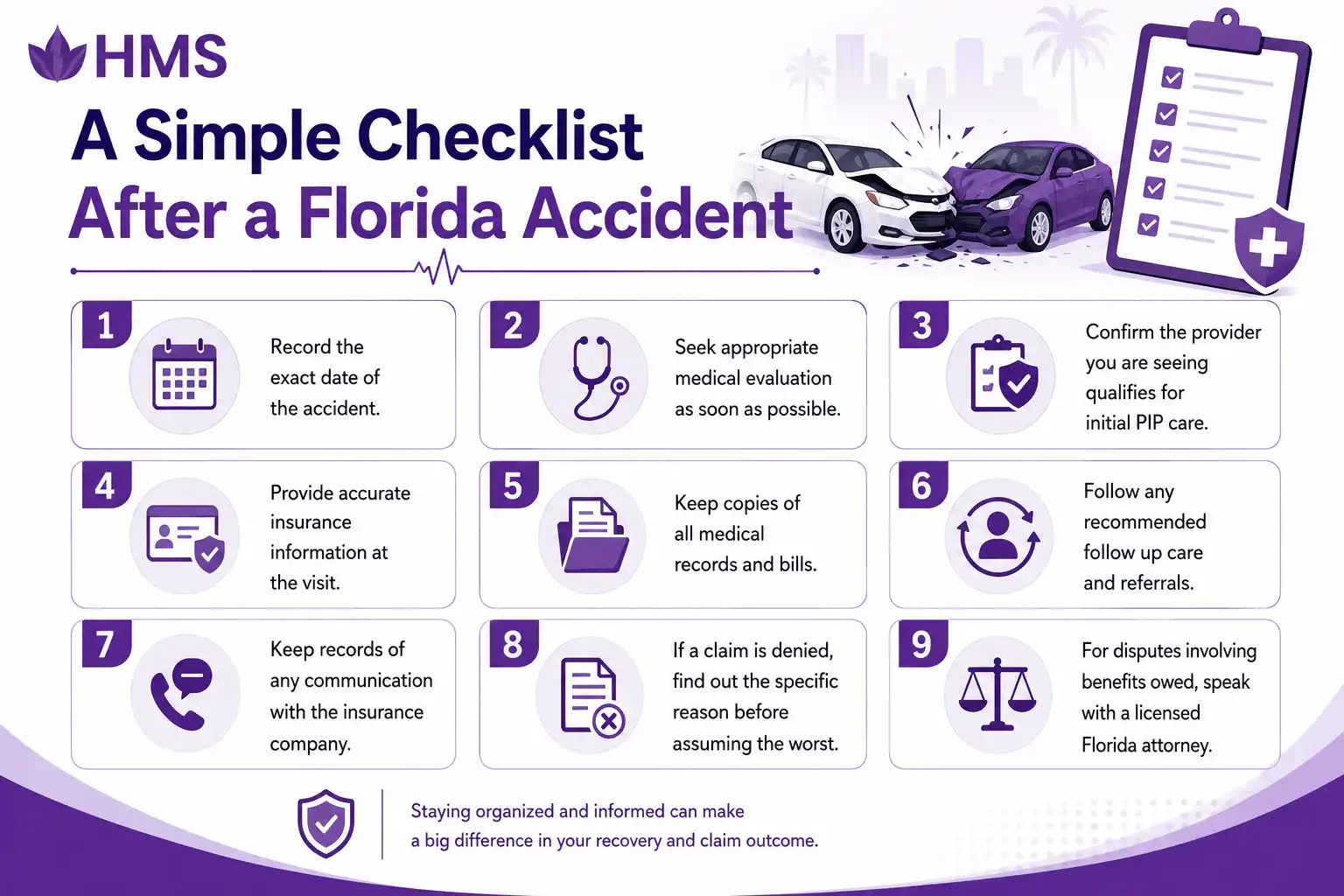
This is where documentation becomes important. The accident date, the date of the visit, the provider's credentials, and the reason for treatment all need to be recorded clearly, since this record is what an insurer will review when deciding whether the claim satisfies the statute.
Who Can Provide Qualifying Initial Care
Not every type of provider counts. Under the current statute, qualifying initial services and care can be provided, supervised, ordered, or prescribed by:
-
A physician licensed under Florida's medical or osteopathic practice laws
-
A dentist
-
A chiropractic physician
-
An advanced practice registered nurse
Initial care can also take place at a hospital or hospital owned facility, or through an appropriately licensed emergency transportation and treatment provider.
This is one area where a lot of accident information online gets imprecise. A physician assistant is not listed among the providers who can deliver the initial 14 day care, though a physician assistant does have a role later on when it comes to determining whether an injury qualifies as an emergency medical condition. Those are two different questions, and mixing them up can lead to a claim being handled incorrectly.
Do You Have to Go to the Emergency Room
No. There is no blanket rule requiring an ER visit. A hospital visit is one qualifying path, but so is a visit to a physician, chiropractic physician, dentist, or APRN. The real requirement is that the care qualifies under the statute, not that it happens in any one specific setting.
What Does Florida PIP Actually Cover
|
PIP Benefit |
What the Law Provides |
|
Medical benefits |
80 percent of reasonable, medically necessary expenses |
|
Disability and lost income |
60 percent of qualifying lost income or earning capacity |
|
Death benefit |
5,000 dollars |
|
Overall medical and disability limit |
Up to 10,000 dollars combined, subject to the emergency medical condition determination |
Medical benefits typically cover medical and surgical services, X-rays, dental care, rehabilitation, and medically necessary ambulance, hospital, and nursing services. Disability benefits address a portion of lost income and certain household services. These are separate categories under the law, and the 14 day requirement is specifically tied to the medical benefits portion.
Florida PIP 2,500 Dollars vs 10,000 Dollars, What Is the Difference
This distinction gets buried in a lot of accident guides, but it is one of the most important parts of the law to understand.
When Can PIP Pay Up to 10,000 Dollars
Reimbursement can reach 10,000 dollars when a qualifying provider determines that the injured person had an emergency medical condition, often shortened to EMC.
When Is PIP Limited to 2,500 Dollars
If a qualifying provider determines there was no emergency medical condition, reimbursement under PIP is limited to 2,500 dollars.
Who Can Determine an Emergency Medical Condition
The providers who can make this determination are a physician, a dentist, a physician assistant, or an APRN. Notice that a chiropractic physician, while able to provide qualifying initial care, is not on the list of providers who can determine an emergency medical condition. This is a meaningful distinction, and it directly affects how much of the claim gets paid.
Who Can Do What
|
Provider or Setting |
Initial Care |
EMC Determination |
|
Physician |
Yes |
Yes |
|
Dentist |
Yes |
Yes |
|
Chiropractic physician |
Yes |
No |
|
APRN |
Yes |
Yes |
|
Physician assistant |
Not listed as an initial care provider |
Yes |
|
Hospital |
Yes |
Depends on the qualifying practitioner involved |
|
Emergency transportation or treatment provider |
Yes |
No |
What Happens to Treatment After the First 14 Days
Can You Continue Treatment After 14 Days
Yes. The 14 day rule governs the initial services and care, not every future visit. Once initial care has been established, follow up treatment operates under its own requirements.
Does Follow Up Care Need a Referral
Generally, follow up services must follow a referral from an appropriate provider and remain consistent with the diagnosis made during the initial visit. Treatment that drifts away from that original diagnosis without a proper referral can create complications for the claim.
Can Physical Therapy Be Covered
Physical therapy can be part of a covered treatment plan, but it needs to fit within this referral and diagnosis framework. Simply visiting a physical therapist on your own does not satisfy the initial 14 day requirement, since physical therapy is typically part of follow up care rather than initial care.
What Happens If You Miss Florida's 14 Day PIP Deadline
Does Missing 14 Days Mean You Lose All PIP Benefits
This is worth answering carefully, because a lot of accident content online overstates it. The 14 day condition is written into the section of the law that governs medical benefits specifically. Missing that window can prevent PIP medical benefits from being payable under that provision. Whether it affects other categories of PIP coverage, such as disability benefits, depends on the specific facts of the claim, and that is not something to state broadly without a licensed attorney reviewing the situation.
What Options May Remain
If the 14 day window was missed, a few paths may still be worth exploring depending on the circumstances, including other applicable insurance coverage or a liability claim against another party. Since these outcomes depend heavily on individual facts, speaking with a licensed Florida attorney is the right next step for anyone in this situation.
Does Fault Matter Under Florida PIP
Not for the medical benefits themselves. PIP is first party, no fault coverage, which means your own policy generally pays your medical expenses regardless of who caused the accident. Fault becomes more relevant if you pursue a claim against another driver's liability coverage, which is a separate process from a PIP claim.
Is Florida PIP Going Away in 2026
This question comes up often, and the honest answer requires separating what was proposed from what actually became law.
What Was Proposed in 2026
A bill known as SB 522 proposed repealing Florida's no fault insurance framework, with a proposed effective date of January 1, 2027. A companion bill in the House, HB 769, proposed similar changes.
Did the Repeal Become Law
No. Both SB 522 and HB 769 died in committee on March 13, 2026, and did not advance further in the legislative process.
2026 Update. The proposed repeal of Florida's PIP framework did not become law. As of August 2026, the 14 day medical treatment requirement remains active under current Florida law.
Florida PIP Rules Medical Providers and Billing Teams Should Know
Understanding the 14 day rule matters just as much on the provider side of the claim as it does for the injured patient. Once treatment begins, a whole set of documentation and billing requirements determine whether that claim actually gets paid.
This is where Florida medical billing services come into the picture, since the accuracy of what happens after the patient walks in the door often decides whether the claim gets paid in full.
Initial Treatment Documentation
Insurers will look closely at the accident date, the date of the first visit, the treating provider's credentials, the diagnosis, and how any follow up care connects back to that original diagnosis. Gaps or inconsistencies in this documentation are a common reason PIP claims run into trouble, separate from the 14 day question entirely.
PIP Medical Billing Timeframes
Providers generally need to submit PIP claims within statutory billing windows, which can extend depending on whether a notice of initiation of treatment is submitted early in the process. Getting this timing wrong, even when the patient's own 14 day care was handled correctly, can still put a claim at risk. Reliable claim submission services help make sure these windows are never missed in the first place.
Exact day counts for these billing windows should be verified against the current statute before publication.
What Happens When a PIP Claim Is Denied
A denial is not always the end of the road. It usually means reviewing the denial reason, confirming the accident and treatment dates line up, verifying that the treating provider qualifies under the statute, checking the supporting documentation, and determining whether the claim needs correction, resubmission, or an appeal. This is exactly the kind of work handled through dedicated denial management services, so a claim that runs into trouble because of a technicality does not turn into lost revenue.
For providers dealing with claims that were paid below what they were actually owed, medical underpayment recovery services can help recover the difference rather than writing it off.
FAQ! Need Help?
It is the requirement that a person injured in a Florida car accident receive qualifying initial medical services and care within 14 days of the accident date in order for PIP medical benefits to apply.
Missing the deadline can prevent PIP medical benefits from being payable under the relevant statute. The effect on other types of PIP benefits depends on the specific circumstances and should be reviewed with an attorney.
A physician, dentist, chiropractic physician, or APRN can provide qualifying initial care, as can a hospital or an appropriately licensed emergency transportation provider.
Yes, but it is not the only option. Several other provider types also qualify for initial care.
Yes, a chiropractic physician can provide qualifying initial care, though a chiropractor is not among the providers who can determine an emergency medical condition.
Yes. PIP is no fault coverage, so the 14 day requirement applies regardless of who caused the accident.
Up to 10,000 dollars combined for medical and disability benefits, subject to the emergency medical condition determination, plus a separate 5,000 dollar death benefit.
The 10,000 dollar limit applies when a qualifying provider determines the injury involved an emergency medical condition. Without that determination, coverage is limited to 2,500 dollars.
Follow up treatment can still be covered after the initial 14 day window, as long as it connects to a proper referral and the original diagnosis.
No. A proposed repeal did not become law. The 14 day requirement and the broader PIP framework remain in effect as of August 2026.
Providers work within statutory billing windows that can vary depending on when a notice of initiation of treatment is filed. Verify current windows before publishing exact day counts.
Review the denial reason, confirm documentation and treatment dates, verify provider eligibility, and determine whether resubmission or an appeal is the right next step.
ABOUT AUTHOR

Temba Altman
As a blog writer with years of experience in the healthcare industry, I have got what it takes to write well-researched content that adds value for the audience. I am a curious individual by nature, driven by passion and I translate that into my writings. I aspire to be among the leading content writers in the world.