The icd 10 code for hyperkalemia in FY2026 is E87.5 — Hyperkalemia. Current 2026 code references identify E87.5 as a billable, valid diagnosis code, and the code was not replaced by a more specific acute, mild, severe, or chronic hyperkalemia code for FY2026.
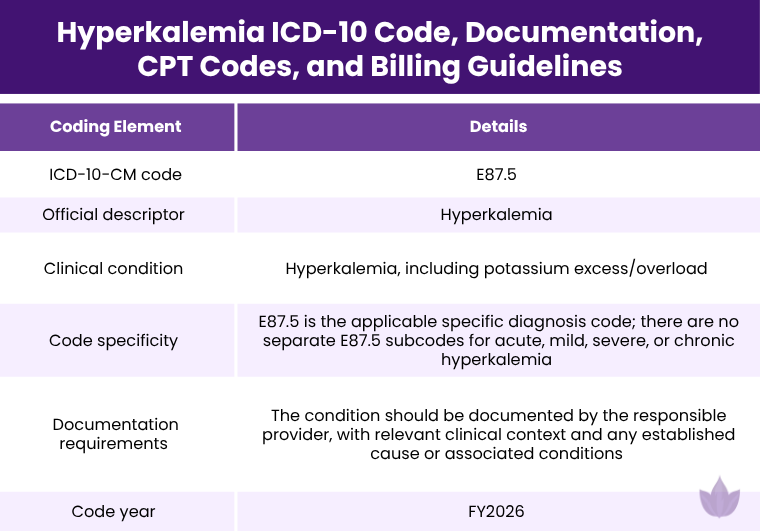
The CDC and CMS maintain the ICD-10-CM code set and its annual updates. For FY2026, the code files cover services from October 1, 2025 through September 30, 2026, with an additional April 1, 2026 update applicable to the second half of the fiscal year.
What Should a Coder Verify Before Assigning E87.5?
Before assigning E87.5, review the complete record and confirm:
-
The provider actually documented hyperkalemia as a diagnosis when provider documentation is required.
-
The condition is active or clinically relevant to the encounter.
-
The documentation is consistent with the laboratory and treatment record.
-
Any established underlying cause is documented.
-
AKI, CKD, renal failure, medication-related effects, or dialysis circumstances are separately considered.
-
Applicable sequencing and additional-code instructions are followed.
-
The correct code-year files are being used.
ICD-10-CM guidelines state that diagnosis assignment is based on documentation from the patient's provider or other qualified practitioner legally responsible for establishing the diagnosis, subject to limited exceptions
Hyperkalemia ICD-10 Code for Acute, Mild, Severe, and Chronic Conditions
The ICD-10-CM code for hyperkalemia in FY2026 is E87.5 — Hyperkalemia. The code remains the same whether the provider documents acute, mild, severe, or chronic hyperkalemia. ICD-10-CM does not assign separate diagnosis codes based solely on the severity or duration of this condition.
Severity should not be assigned from a potassium value alone. Laboratory results, provider documentation, associated symptoms, and the clinical circumstances must be evaluated together. An abnormal potassium result does not automatically establish a separately reportable diagnosis without applying the coding rules relevant to the encounter.
When Additional Diagnosis Codes May Be Necessary
Although E87.5 identifies hyperkalemia, the complete coding picture may require additional codes when other conditions or circumstances are documented and reportable.
For example, a patient with hyperkalemia and chronic kidney disease may require coding for both conditions. Similarly, documented acute kidney injury, a medication-related adverse effect, or a dialysis-related circumstance may affect code selection and sequencing.
Coders should review the applicable ICD-10-CM Official Guidelines, the Alphabetic Index, and the Tabular List before finalizing the claim.
Coding takeaway: Use E87.5 for documented hyperkalemia. Do not create separate codes for acute, mild, severe, or chronic hyperkalemia merely because those descriptors appear in the medical record.
History of Hyperkalemia
The appropriate coding approach for a history of hyperkalemia depends on whether the condition is currently active or has resolved.
For a history of hyperkalemia ICD-10 query, coders should determine whether the previous episode remains relevant to the current encounter and whether history coding is appropriate under the applicable ICD-10-CM guidelines.History codes are used when the historical condition is no longer active but remains relevant to current care or influences treatment.
Z86.39 — Personal history of other endocrine, nutritional and metabolic diseases may be relevant when the documented circumstances support its use. Verify the code's application against the current Alphabetic Index and Tabular List before assigning it.
Documentation Considerations
-
Confirm whether hyperkalemia is active or resolved.
-
Review whether the previous episode affects current treatment or medical decision-making.
-
Do not substitute a history code for an active diagnosis.
-
Do not assign a history code automatically just because hyperkalemia appears in an older medical record.
Coding tip: A documented history of hyperkalemia and a current episode of hyperkalemia represent different coding situations. Determine the patient's current clinical status before selecting the diagnosis code.
For another example involving history coding, see History of Seizures ICD-10 Code.
Hyperkalemia ICD-10 Coding With CKD, AKI, and Renal Failure
Hyperkalemia may occur alongside chronic kidney disease (CKD), acute kidney injury (AKI), or other forms of renal dysfunction. Although E87.5 identifies documented hyperkalemia, the additional diagnosis codes depend on the specific renal condition established in the medical record.
Hyperkalemia With Chronic Kidney Disease (CKD)
When a provider documents hyperkalemia alongside CKD, E87.5 may be reported with the applicable N18.- code for the documented CKD stage, when both conditions are reportable.
For coders searching for the ICD-10 code for hyperkalemia due to CKD, it is important to distinguish the hyperkalemia diagnosis from the underlying renal condition. Review the provider's documentation, CKD stage, and any applicable combination-code or sequencing instructions.
Do not assume a causal relationship solely because hyperkalemia and CKD appear in the same record.
Hyperkalemia With Acute Kidney Injury (AKI)
For AKI with hyperkalemia ICD-10 coding, E87.5 may be reported with the applicable N17.- code when the provider documents both conditions and both are reportable.
The specific AKI code should reflect the documented diagnosis. Coders should not independently diagnose AKI from a change in creatinine or another laboratory finding without applying the relevant documentation and coding rules.
Hyperkalemia With Renal Failure
The phrase "renal failure" can describe different clinical situations, so coders should identify the specific condition documented by the provider.
| Documented renal condition | Coding consideration |
|---|---|
| Chronic kidney disease | Consider the applicable N18.- code and documented stage. |
| Acute kidney injury or acute kidney failure | Consider the appropriate N17.- code. |
| End-stage renal disease | Consider N18.6 when ESRD is documented and reportable. |
| Renal failure without sufficient specificity | Review the documentation and seek clarification when appropriate. |
Coding takeaway: Do not use the same coding approach for every renal condition. Identify the documented diagnosis, confirm its specificity, and review the applicable code-year guidelines before submitting the claim.
Drug-Induced Hyperkalemia
-
Code the nature of the adverse effect first — in this scenario, E87.5 for hyperkalemia.
-
Follow it with the applicable T36-T50 adverse-effect code identifying the drug or drug class, using the appropriate fifth/sixth character for adverse effect and the required 7th character.
For example, current 2026 code references contain adverse-effect codes for specific drug classes, such as T50.0X5A for an adverse effect involving mineralocorticoids and their antagonists, when that exact drug category applies.
Do not use the same adverse-effect approach for a poisoning event. Poisoning has a different sequencing rule: the poisoning code is sequenced first, with manifestations coded additionally. Underdosing is also a separate situation and should not be confused with a properly administered adverse effect.
Hyperkalemia Due to Missed Dialysis
When the provider documents hyperkalemia after a missed dialysis treatment and the missed treatment meets ICD-10-CM criteria for renal-dialysis noncompliance, the coding may include:
-
E87.5 for hyperkalemia.
-
Z91.158 — Patient's noncompliance with renal dialysis for other reason, when that is the documented circumstance.
-
Z91.151 instead when the documented reason is financial hardship.
-
Applicable ESRD/renal disease and dialysis-status coding when supported by the record.
Current 2026 code references identify Z91.158 as a billable code for noncompliance with renal dialysis for other reason.
The critical distinction is why the dialysis was missed. A patient intentionally skipping dialysis is different from a treatment missed because of transportation, a facility cancellation, scheduling problems, hospitalization, or another circumstance. Do not infer noncompliance merely from the fact that a dialysis session did not occur.
What Documentation Is Required to Code Hyperkalemia?
Accurate hyperkalemia coding starts with the provider's diagnostic statement, not simply the potassium number.
The FY2026 ICD-10-CM guidelines state that code assignment is based on provider documentation and that the entire medical record should be reviewed for the level of certainty established during the encounter.
Documentation Should Address, When Applicable
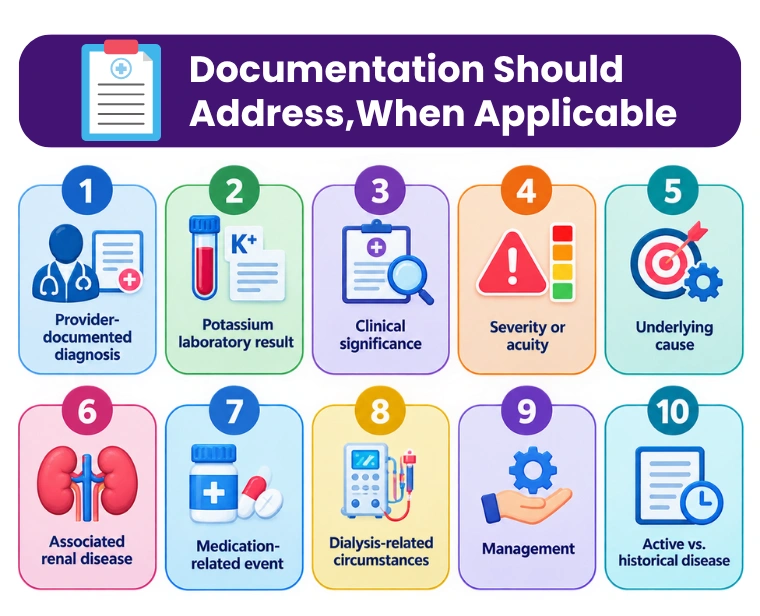
1- Provider-documented diagnosis: The assessment, diagnosis, discharge summary, progress note, or other appropriate clinical documentation should establish hyperkalemia.
2- Potassium laboratory result: Include the potassium result when it helps demonstrate clinical significance, treatment response, or medical necessity. The number itself does not automatically create a diagnosis.
3- Clinical significance: When a laboratory result is abnormal but the provider does not diagnose hyperkalemia, coders should apply the rules for the applicable setting and query when appropriate rather than assuming the diagnosis.
4- Severity or acuity: Document "mild," "moderate," "severe," "acute," or "chronic" when those distinctions are clinically relevant. Remember that these descriptors do not create separate E87.5 codes.
5- Underlying cause: If hyperkalemia is attributed to CKD, AKI, medication therapy, missed dialysis, metabolic disease, or another condition, the cause should be clearly documented.
6- Associated renal disease: For CKD, documentation should identify the stage when known. For AKI, the provider should explicitly diagnose AKI rather than requiring the coder to infer it from laboratory changes.
7- Medication-related event: Document the implicated medication and whether the event represents an adverse effect, poisoning, or another type of medication-related problem.
8- Dialysis-related circumstances: Document whether dialysis was missed, why it was missed, the patient's dialysis status, and the clinical relationship to hyperkalemia.
9- Management: Repeat potassium testing, ECG evaluation, medication adjustment, emergency treatment, infusion/IV therapy, and dialysis may provide important clinical context, although services must still be coded according to the actual service performed.
10- Active vs. historical disease: Distinguish an active problem under treatment or evaluation from a resolved condition that is relevant only as past history.
Outpatient vs. Inpatient Documentation Matters
One of the most frequently overlooked distinctions is the coding rule for uncertain diagnoses.
For outpatient encounters, diagnoses documented as "probable," "suspected," "rule out," or similar uncertain terminology are generally not coded as if established. Instead, code the condition to the highest level of certainty known for that encounter.
In the inpatient setting, the rules for uncertain diagnoses documented at discharge are different. Under the inpatient guidelines, certain uncertain diagnoses documented as established at discharge may be coded as if they existed.
This distinction becomes particularly important when a provider writes something such as "possible hyperkalemia" after an initial abnormal laboratory result.
Hyperkalemia Documentation Checklist
Before final coding, verify:
|
Documentation Element |
What to Look For |
|
Diagnosis |
Explicit provider documentation of hyperkalemia |
|
Lab support |
Potassium result and clinical context |
|
Specimen concerns |
Hemolysis or pseudohyperkalemia addressed when relevant |
|
Acuity |
Acute/chronic status if clinically relevant |
|
Severity |
Mild/severe or other description if clinically relevant |
|
Cause |
CKD, AKI, medication, dialysis issue, or other documented cause |
|
Renal status |
CKD stage, AKI, ESRD, or other specific renal diagnosis |
|
Medication |
Drug name/class and nature of medication-related event |
|
Dialysis |
Missed session and documented reason |
|
Treatment |
Actual clinical management performed |
|
Status |
Active condition vs. resolved history |
|
Setting |
Outpatient vs. inpatient rules applied correctly |
For documentation-related revenue-cycle issues, the M127 Remark Code guide can be used as related reading when a payer requests missing medical records.
CPT Codes Commonly Associated With Hyperkalemia
A diagnosis code and a procedure code are not interchangeable.
ICD-10-CM identifies diagnoses. CPT identifies physician and other qualified professional services and procedures. A hyperkalemia diagnosis does not automatically create a CPT charge. The CPT code depends on what the clinician actually performed, documented, and reported, as well as the setting and applicable payer rules.
The AMA identifies the current CPT Professional Edition as the official source for CPT code descriptors and guidelines.
The following codes are examples of services that may be associated with an encounter involving hyperkalemia. They are not automatically reportable merely because E87.5 is present.
|
CPT Code |
Verified Service Description |
Clinical Context |
Documentation Requirements |
Coding Considerations |
|
84132 |
Potassium, serum/plasma/whole blood |
Isolated potassium measurement |
Test order, specimen/result, medical necessity |
Use when an individual potassium test is performed; do not assume it is separately reportable when included in an appropriately billed panel |
|
80048 |
Basic metabolic panel |
Electrolyte/renal/metabolic assessment |
Documentation supporting the panel and component tests |
Panel rules apply; components should not be unbundled contrary to CPT/NCCI rules |
|
80053 |
Comprehensive metabolic panel |
Broader metabolic evaluation |
Documentation supporting the full panel |
Do not separately report individual component tests when prohibited |
|
93000 |
Routine ECG including tracing and interpretation/report |
Hyperkalemia evaluation when ECG is clinically indicated and performed |
ECG tracing and interpretation/report |
Global ECG service when requirements are satisfied |
|
93005 |
Routine ECG tracing only |
Technical/tracing component |
ECG tracing documentation |
Appropriate only when the tracing-only service is actually furnished/reportable |
|
93010 |
ECG interpretation/report only |
Professional interpretation |
Physician/QHP interpretation/report |
Appropriate only for the interpretation component |
|
99202 – 99215 |
Office/outpatient E/M services |
Office or outpatient assessment/management |
Medical necessity and E/M documentation |
Code selection depends on current E/M rules, including MDM/time as applicable |
|
99281 – 99285 |
Emergency department E/M services |
Emergency assessment of symptomatic/clinically significant hyperkalemia |
ED documentation and medical necessity |
Hyperkalemia alone does not determine the E/M level |
|
96365 |
Initial IV infusion service, up to 1 hour |
When a qualifying infusion is actually administered |
Medication, route, start/stop times and required infusion documentation |
Setting and payer rules affect professional reporting |
|
96374 |
Initial IV push service |
When a qualifying IV push is performed |
Drug, route, administration details and required documentation |
Do not report merely because medication treatment occurred |
|
90935 |
Hemodialysis procedure with a single physician/QHP evaluation |
Relevant to physician involvement in hemodialysis |
Dialysis and professional-service documentation |
Follow payer, provider, and setting rules; same-day services may be subject to bundling/inclusion rules |
The laboratory panel codes above should be treated as panel services rather than a menu of individual components. Current coding references describe 80048 as a basic metabolic panel containing the required components, while 84132 is used for an individual potassium test.
For ECG services, 93000 combines the tracing and interpretation/report, while 93005 represents the tracing-only component and 93010 represents the interpretation/report component.
Current E/M coding must follow the CPT E/M guidelines rather than being selected from the diagnosis alone.
Similarly, IV administration coding depends on what was actually administered and how the service was performed and documented. Medicare administrative guidance also illustrates why professional reporting can differ between office and hospital outpatient/ED settings.
For more cardiology-oriented CPT education, You can read Cardiology CPT Codes and Stress Test CPT Codes.
For E/M examples, see CPT Code 99205.
Do Not Assume These CPT Codes Are Required
A common billing mistake is to treat hyperkalemia as a trigger for a predefined collection of CPT codes.
That is not correct.
A patient may have E87.5 without an ECG, without an isolated potassium test, without an IV administration service, and without dialysis. Conversely, an encounter may include several of these services, depending on the clinical circumstances.
CPT reporting must reflect the actual service performed, documented, medically necessary, and reportable under the applicable payer and setting rules.
The CMS National Correct Coding Initiative (NCCI) policy manual should also be reviewed when bundling, modifier, or procedure-edit questions arise.
How ICD-10-CM E87.5 Supports Medical Necessity
E87.5 communicates that the patient has documented hyperkalemia. That diagnosis can help explain why a clinician ordered or performed services such as potassium testing, metabolic panels, ECG evaluation, emergency assessment, treatment administration, or dialysis-related services.
However, an ICD-10-CM diagnosis code does not guarantee reimbursement.
Medical necessity is determined through the relationship among:
-
The patient's documented clinical condition.
-
The service or procedure performed.
-
The documentation supporting that service.
-
Applicable CPT/HCPCS rules.
-
Payer coverage policies.
-
NCCI or other claim-editing rules.
-
The setting in which the service was performed.
Diagnosis sequencing also matters. The principal diagnosis in an inpatient admission is governed by the inpatient definition and circumstances of the admission, while outpatient claims use first-listed diagnosis rules. The fact that hyperkalemia may be clinically urgent does not, by itself, establish that E87.5 must always be first.
For a related discussion of diagnosis/procedure mismatch, see CO 11 Denial Code guide.
Common Hyperkalemia Coding Errors
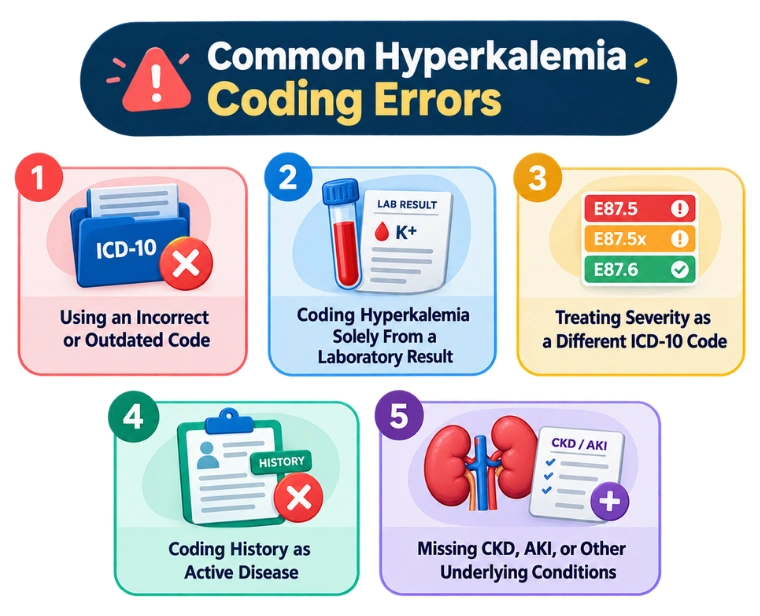
1. Using an Incorrect or Outdated Code
A coder may use a code from a different code year or rely on an outdated online article.
Correct approach: Verify E87.5 in the applicable ICD-10-CM code set for the date of service. FY2025 and FY2026 both use E87.5 for hyperkalemia, but fiscal-year dates still matter.
2. Coding Hyperkalemia Solely From a Laboratory Result
A potassium value above the reference range does not, by itself, always establish the diagnosis for coding.
Correct approach: Review the provider's documentation and the complete record. Consider whether the provider addressed the abnormality as clinically significant hyperkalemia.
3. Treating Severity as a Different ICD-10 Code
"Mild" or "severe" does not create a separate E87.5 code.
Correct approach: Code E87.5 when hyperkalemia is documented and separately capture other reportable conditions or services supported by the encounter.
4. Coding History as Active Disease
A resolved prior episode should not automatically be coded as active hyperkalemia.
Correct approach: Determine whether the condition is current. When a historical condition is relevant, apply the appropriate history-code guidance.
5. Missing CKD, AKI, or Other Underlying Conditions
Coding only E87.5 can underrepresent the clinical complexity when the provider also documents CKD or AKI.
Correct approach: Identify and report documented associated conditions that meet coding/reporting requirements, including CKD stage where required.
Hyperkalemia ICD-10 Claim Denials Causes & Preventions
Hyperkalemia claims can face denials, claim rejections, medical-necessity concerns, requests for records, or payment delays. The reason is not universal across payers, so the remittance advice, claim edits, payer policy, and clinical documentation must be reviewed together.
1. Insufficient or Inconsistent Diagnosis Documentation
Why it occurs: The claim reports E87.5, but the medical record does not clearly establish hyperkalemia.
Review: Assessment/plan, discharge summary, relevant provider notes, lab results.
Prevent it: Ensure the diagnosis is documented and clinically supported before final billing.
Pre-submission check: Does the record clearly connect the diagnosis with the encounter?
2. Missing Supporting Clinical Information
Why it occurs: The payer cannot validate the service or asks for additional records.
Review: Potassium results, ECG report, treatment documentation, progress notes, and relevant physician documentation.
Prevent it: Maintain complete medical records that support the billed service.
3. Medical Necessity Concerns
Why it occurs: The payer determines that the service does not meet its medical-necessity policy.
Review: The payer's LCD, NCD, local coverage policy, commercial policy, and the documentation supporting the billed service.
Prevent it: Link the service to the diagnosis and clinical circumstances supported by the record.
See CO 50 Denial Code guide for related medical-necessity denial education.
4. Diagnosis-to-Procedure Mismatch
Why it occurs: The billed procedure does not align with the diagnoses submitted or the diagnosis is too nonspecific for the payer's policy.
Review: CPT code, ICD-10 codes, modifiers, medical record, and payer policy.
Prevent it: Validate the diagnosis-to-procedure relationship before claim submission.
Related resource: CO 11 Denial Code.
5. Incorrect or Outdated Diagnosis Code
Why it occurs: A coder uses the wrong fiscal-year code set or an outdated code from an older resource.
Review: Date of service and applicable ICD-10-CM release.
Prevent it: Verify the code in the correct annual code set.
6. Unsupported Additional Diagnoses
Why it occurs: CKD, AKI, medication-related conditions, or noncompliance codes are reported without adequate documentation.
Review: Each secondary diagnosis independently.
Prevent it: Report only diagnoses supported by the medical record and applicable coding rules.
7. Incorrect Sequencing or Incomplete Coding
Why it occurs: Hyperkalemia is automatically sequenced first, or an underlying condition that affects coding is omitted.
Review: Reason for encounter/admission, provider documentation, Tabular List, and setting.
Prevent it: Apply inpatient principal-diagnosis or outpatient first-listed rules as appropriate.
8. Missing Documentation for Medication- or Dialysis-Related Circumstances
Why it occurs: The claim says "drug-induced" or "missed dialysis" without documenting the medication relationship or reason the treatment was missed.
Review: Medication administration, adverse-effect documentation, dialysis records, and the stated reason for missed treatment.
Prevent it: Document the clinical relationship rather than relying on coder inference.
9. Payer-Specific Requirements
Why it occurs: A payer may require specific diagnosis combinations, medical-necessity documentation, modifiers, or prior authorization.
Review: Payer policy and remittance details.
Prevent it: Treat payer guidance as an additional layer of requirements, not a replacement for ICD-10-CM or CPT rules.
Hyperkalemia Coding Examples
The following are hypothetical educational examples intended to demonstrate coding logic. They are not substitutes for official coding guidance, payer instructions, or a complete review of the medical record.
Example 1: Unspecified Hyperkalemia
Hypothetical scenario:
An established outpatient patient has a potassium result above the laboratory reference range. The provider documents "hyperkalemia," orders repeat testing, and adjusts the patient's medication.
Provider documentation:
"Hyperkalemia. Repeat potassium today. Review potassium-raising medications."
Coding approach:
Report E87.5 for the documented active hyperkalemia.
Additional considerations:
Do not create a separate acute, mild, or severe code merely from the laboratory value.
Potential risk:
If the provider had documented only "elevated potassium" without diagnosing hyperkalemia, the coder should review the setting-specific rules and clinical significance rather than automatically assigning E87.5.
Example 2: Hyperkalemia With CKD
Hypothetical scenario:
A patient with documented CKD stage 4 is evaluated for elevated potassium. The provider states, "Hyperkalemia in the setting of CKD stage 4."
Provider documentation:
"Hyperkalemia. CKD stage 4. Continue renal management and repeat BMP."
Coding approach:
Report E87.5 plus the appropriate N18.- CKD stage code, including N18.4 when stage 4 is documented.
Additional considerations:
Review whether hypertensive CKD, diabetes with CKD, or another underlying etiology is documented and requires additional coding under the applicable guidelines.
Potential risk:
Do not infer that all hyperkalemia in CKD is necessarily "due to CKD" unless the provider establishes the relationship where such a relationship matters for the coding decision.
Example 3: AKI With Hyperkalemia
Hypothetical scenario:
A hospitalized patient develops acute kidney injury and hyperkalemia during the admission. The provider documents both conditions and treats both.
Provider documentation:
"AKI with hyperkalemia. Continue renal evaluation and electrolyte management."
Coding approach:
Report E87.5 for hyperkalemia plus the appropriate N17.- code for the documented AKI.
Additional considerations:
The specific N17.- code should follow the provider's documented type. Do not assume a more specific AKI code than the record supports.
Potential risk:
Coding AKI solely from a creatinine change without provider documentation can create a compliance problem.
Example 4: Medication-Related Hyperkalemia
Hypothetical scenario:
An inpatient provider documents that a properly taken medication caused hyperkalemia and discontinues the medication.
Provider documentation:
"Hyperkalemia due to adverse effect of [documented medication]."
Coding approach:
Report E87.5 first for the nature of the adverse effect, followed by the appropriate T36-T50 adverse-effect code for the implicated medication/class.
Additional considerations:
The exact T code depends on the medication. For certain mineralocorticoid antagonists, a current code such as T50.0X5A may apply when the documented drug falls within that category and the encounter meets the initial-adverse-effect requirements.
Potential risk:
Do not use an adverse-effect code when the actual event was poisoning or underdosing. Those circumstances follow different rules.
Hyperkalemia ICD-10 Coding Checklist
Before submitting a claim containing E87.5, use this practical review:
Diagnosis
-
Confirm that the provider documented hyperkalemia.
-
Confirm that the condition is active or otherwise reportable for the encounter.
-
Review the complete record rather than coding from the potassium value alone.
Code-year validation
-
Confirm the applicable date of service.
-
Verify the correct ICD-10-CM release.
-
Confirm that E87.5 is the current applicable code.
Specificity
-
Check whether acute, chronic, mild, or severe status is documented.
-
Remember that these descriptions do not create separate E87.5 codes.
-
Verify whether the record describes true hyperkalemia versus an unexplained or potentially spurious laboratory elevation.
Underlying conditions
-
Review CKD stage.
-
Review AKI.
-
Review renal failure/ESRD status.
-
Review documented medication relationships.
-
Review dialysis-related circumstances.
Additional codes and sequencing
-
Check Tabular List instructions.
-
Check combination-code rules.
-
Check applicable additional-code instructions.
-
Apply inpatient versus outpatient sequencing rules correctly.
-
Report only diagnoses supported by documentation.
CPT and medical necessity
-
Confirm the actual service performed.
-
Match the diagnosis to the service.
-
Check panel and bundling rules.
-
Check NCCI edits where applicable.
-
Review payer-specific medical-necessity requirements.
Final claim review
-
Verify all code descriptors.
-
Confirm modifiers and units where applicable.
-
Confirm supporting documentation is available.
-
Review the payer's claim edits and policy.
-
Do not assume E87.5 alone guarantees payment.
Authoritative External References
For publication and ongoing maintenance, use these primary or authoritative resources:
CMS ICD-10 code sets and annual updates
CMS FY2026 ICD-10-CM Official Guidelines for Coding and Reporting
CMS National Correct Coding Initiative Policy Manual
National Kidney Foundation: Hyperkalemia
MSD Manual Professional: Hyperkalemia
Final Takeaway
The hyperkalemia ICD-10 code is E87.5 — Hyperkalemia. There are no separate ICD-10-CM subcodes under E87.5 for acute, mild, severe, or chronic hyperkalemia.
The more difficult coding decisions arise when hyperkalemia appears with CKD, AKI, renal failure, medication adverse effects, or missed dialysis. In those cases, the coder must determine whether additional diagnosis codes are supported, whether a specific sequencing rule applies, and whether the provider documentation clearly establishes the underlying relationship.
For billing, remember that E87.5 is a diagnosis code, not a procedure code. CPT reporting must reflect the actual services performed and documented, while medical necessity and payment remain subject to payer policy, coding rules, and claim-edit requirements.
ABOUT AUTHOR

Temba Altman
As a blog writer with years of experience in the healthcare industry, I have got what it takes to write well-researched content that adds value for the audience. I am a curious individual by nature, driven by passion and I translate that into my writings. I aspire to be among the leading content writers in the world.