The AI modifier in medical billing stands for Principal Physician of Record. It has nothing to do with artificial intelligence. It tells the payer which physician is in charge of a patient's overall care during a hospital or nursing facility admission.
This guide explains what the AI modifier means, which CPT codes it applies to, who uses it, what documentation supports it, and how to avoid denials. It is written for physicians, practice owners, and medical coders.
What Does Modifier AI Stand For?
Modifier AI stands for Principal Physician of Record. It is a HCPCS Level II modifier that the admitting or attending physician adds to an initial hospital or nursing facility care code. It identifies the physician who oversees the patient's overall care and separates that physician from specialists providing specialty care.
Why CMS created it
CMS introduced modifier AI for dates of service on or after January 1, 2010, when Medicare stopped recognizing consultation codes. Without consult codes, the admitting physician and every visiting specialist could report the same initial hospital care codes on the same day. Payers had no way to tell who actually admitted the patient, so overlapping claims looked like duplicates. Modifier AI solved that by flagging one physician per admission.
AI, not A1
The modifier is the letter I, not the number 1. Early references showed it as A1, which confused coders. If your EHR or charge-entry screen lists A1, correct it. Getting modifiers like this right is core to accurate medical coding, because one wrong character can hold up an otherwise clean claim.
AI Modifier CPT Code Rules
Modifier AI goes on initial visit codes only: 99221-99223 for hospital care and 99304-99306 for nursing facility care. It is not reported on subsequent visits or on procedure codes.
|
CPT code range |
Service |
Append AI? |
|---|---|---|
|
99221-99223 |
Initial hospital inpatient or observation care |
Yes, admitting or attending physician only |
|
99304-99306 |
Initial nursing facility care |
Yes, admitting or attending physician only |
|
99231-99233 |
Subsequent hospital care |
No |
|
Procedure codes and other E/M codes |
Any other service |
No |
How observation stays are handled in 2026
In 2026, 99221-99223 report initial hospital inpatient or observation care under one code family, and Medicare contractors list modifier AI for these codes. The admitting physician appends AI whether the patient is placed in observation or admitted as an inpatient.
If a patient moves from observation to inpatient during the same stay, the same practitioner does not report a second initial visit. Older articles that exempt observation stays from AI describe the earlier, pre-merger code set, so do not rely on them.
Hospitalist and attending claims are a routine part of physician billing. Build this code-range rule into your charge-entry workflow so the modifier is applied automatically, not remembered manually.
Who Uses the AI Modifier, and Who Doesn't?
Only the admitting or attending physician who oversees the patient's care appends modifier AI. Consultants and other specialists do not. Medicare contractors treat an initial visit without AI as specialty care.
A worked example
A hospitalist admits a Medicare patient, and a cardiologist sees the same patient on the same day.
|
Physician |
Role |
Claim |
|---|---|---|
|
Hospitalist |
Admitting physician |
Initial hospital care code with AI, for example 99222-AI |
|
Cardiologist |
Specialist |
Own initial service without AI |
Because the hospitalist's claim carries AI, the payer can see who is the principal physician and does not reject the cardiologist's claim as a duplicate. Under the current Medicare Claims Processing Manual, a specialist whose first evaluation meets the code requirements reports 99221-99223 without AI. Some commercial payers handle consultations differently, so always bill each payer by its own policy.
Three rules to remember
- One AI per admission. It is appended once, on the initial visit.
- Same group, same specialty. CMS counts physicians of the same specialty in the same group practice as one practitioner for initial visits, so only one of them reports the initial visit, and that claim carries AI.
- Management responsibility. Medicare expects the physician who reports AI to take on management of the patient's care during the stay. If an NP sees the patient first and the physician follows face-to-face later the same day, the physician's claim carries AI. Within the same group, the visit may qualify as split/shared.
When to Use Modifier AI: A Five-Question Checklist
Use modifier AI when you are the admitting or attending physician reporting the initial visit of an admission. Before you submit, answer these five questions:
- Are you the admitting or attending physician overseeing the patient's care?
- Is this the initial visit of the admission?
- Is the code 99221-99223 or 99304-99306?
- Is AI placed after any payment modifiers on the line?
- Does the payer follow CMS rules for modifier AI?
If all five answers are yes, append AI. If any answer is no, leave it off and check the payer's policy.
Is Modifier AI a Payment Modifier or Informational?
Modifier AI is informational. It does not change the allowed amount, so 99223 pays the same with or without it. Medicare contractors describe it as an identifier, not a pricing modifier.
For 2026, the CY 2026 Medicare Physician Fee Schedule final rule took effect on January 1, 2026. CMS excluded time-based codes, including E/M services, from the efficiency adjustment it finalized, and current Medicare contractor guidance still describes modifier AI as informational only.
That does not make it optional. Some payers state that a claim may be denied when AI is missing, and the modifier is also what keeps a same-day specialist's claim from being rejected as a duplicate. For a practice owner, the cost of leaving it off is not a lower rate. It is rework, delayed cash flow, and avoidable follow-up on claims that should have paid the first time.
AI Modifier Documentation Requirements
The medical record must show that the billing physician is the admitting or attending physician and that the initial visit supports the level billed. The modifier does not replace documentation. It only labels it.
A defensible record for a claim with modifier AI includes:
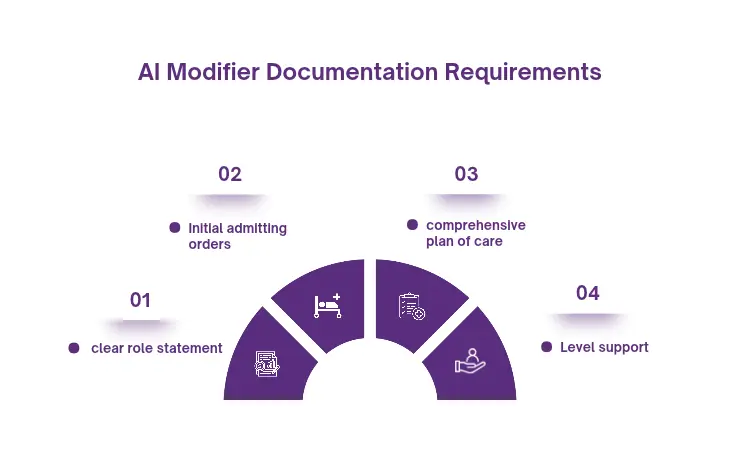
- A clear role statement: the physician is identified as the admitting or attending physician responsible for the patient's overall care.
- Initial admitting orders: entered or authenticated by that physician.
- A comprehensive plan of care: written, signed, or verified by the principal physician.
- Level support: medical decision-making or total time that supports 99221, 99222, or 99223. In 2026, the same MDM and time thresholds (40, 55, and 75 minutes for 99221, 99222, and 99223) apply whether the patient is in inpatient or observation status.
Coders should confirm these elements before the modifier is added, not after a denial. A periodic medical billing and coding audit is an efficient way to find missing modifiers and level mismatches before a payer does.
How to Avoid Denials with Modifier AI
Most AI-related denials come from six repeatable mistakes. Each has a simple fix.
|
Mistake |
Fix |
|---|---|
|
The admitting physician forgets AI on 99221-99223 or 99304-99306 |
Add a charge-entry or claim-scrubber edit that flags initial care codes without AI when the billing provider is the attending |
|
A consultant appends AI |
Train staff that AI is for the admitting or attending physician only, once per admission |
|
AI is added to subsequent visits or procedure codes |
Restrict the modifier to initial care codes in your billing system |
|
AI is placed before payment modifiers |
Sequence AI after payment modifiers |
|
A1 is entered instead of AI |
Check the modifier list in your EHR and charge master |
|
Every payer is assumed to follow CMS |
Review each payer's modifier policy, especially for Medicare Advantage and commercial plans |
Prevent first, then recover
The cheapest denial is the one that never happens. A disciplined claim submission process with pre-submission edits catches missing and misplaced modifiers before the payer sees them.
When a denial does arrive, work it quickly. Identify the denial reason, correct the modifier or documentation, and resubmit within the payer's filing window. A structured denial management process tracks these patterns so the same error does not repeat, and consistent AR follow-up keeps corrected claims from stalling in the queue.
Does Medicare Require the AI Modifier?
Yes. Medicare expects the admitting or attending physician to append modifier AI to the initial hospital or nursing facility care code. The requirement is rooted in CMS instructions in the Medicare Claims Processing Manual (Publication 100-04, Chapter 12, Section 30.6).
Outside traditional Medicare, the answer depends on the payer. Medicare Advantage plans may require it, and some payers publish AI guidance for their Medicare lines of business only. Commercial payers vary, so check each payer's modifier policy before assuming the rule applies.
Final Thoughts
The AI modifier is small, but it does real work. It marks the principal physician of record, protects same-day specialist claims from duplicate rejections, and keeps admission claims moving. Apply it once per admission, on initial care codes 99221-99223 and 99304-99306, only when you are the admitting or attending physician, and back it with clear documentation.
If modifier errors keep sending hospitalist or physician claims back for rework, our team can help. Visit HMS USA LLC to see how we keep claims clean from charge entry to payment.
FAQ! Need Help?
No. Modifier AI is reserved for the admitting or attending physician who oversees the patient's care. Consultants and specialists report their own services without it. Only one physician per admission reports AI, and it appears on the initial visit only.
Yes. Medicare expects the admitting or attending physician to append AI to initial hospital care (99221-99223) and initial nursing facility care (99304-99306). Medicare Advantage and commercial plans may differ, so verify each payer's policy.
It is informational. Modifier AI does not increase or decrease the allowed amount for the visit. Its purpose is to identify the principal physician of record, and leaving it off can still lead to denials or reviews.
Other physicians' same-day E/M claims may not be paid. CGS Medicare notes these claims can deny with remark code M86, and the admitting physician's office can request a claim reopening to add the missing modifier.
AI identifies the principal physician of record. Under CGS Medicare guidance, if an NP sees the patient first and the physician follows face-to-face later that day, the physician's claim carries AI. NPs bill admissions only where state rules authorize it.
ABOUT AUTHOR

Tyler Rex
As a blog writer with years of experience in the healthcare industry, I have got what it takes to write well-researched content that adds value for the audience. I am a curious individual by nature, driven by passion and I translate that into my writings. I aspire to be among the leading content writers in the world.