CPT code 99204 is a new-patient office or outpatient visit billed on moderate medical decision making (MDM) or at least 45 minutes of total provider time on the date of the encounter.
For the 2026 calendar year, the Centers for Medicare & Medicaid Services (CMS) has established the national non-facility reimbursement amount for CPT code 99204 at $177.36, though actual payments will vary by geographic locality adjustments.
What Is CPT Code 99204?
99204 is an Evaluation and Management (E/M) code for a new patient seen in an office or other outpatient setting. The AMA descriptor calls for a medically appropriate history and/or exam plus moderate MDM.
It sits in the middle of the new-patient ladder (99202 to 99205). It typically fits a new patient with more than one problem, or one problem that needs real work: a prescription started, a workup ordered, a differential to sort out. Our medical coding services team handles E/M leveling.
CPT Code 99204 Description and Time Requirement
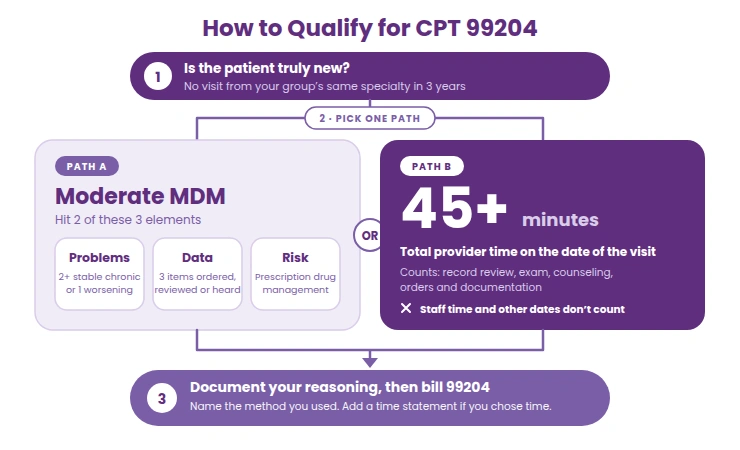
You can pick the level using either MDM or total time. Use whichever one your documentation supports better.
On time, the rule changed in 2024. Before 2024, CPT listed a range for 99204 (45 to 59 minutes). Since the 2024 code set, CPT lists only the minimum: 45 minutes must be met or exceeded. At 60 minutes, you've reached 99205 territory by time.
"Total time" means the provider's own time on the calendar date of the visit, not just face-to-face. It can include:
- Reviewing outside records and test results
- Taking the history and examining the patient
- Counseling and education
- Ordering, referring, and documenting
- Care coordination, if done by you that day
Clinical staff time and time spent on other dates don't count.
How to Qualify for 99204 Using Medical Decision Making
MDM has three elements. You need two of three at the moderate level.
|
MDM element |
What "moderate" looks like |
|---|---|
|
Problems |
One or more chronic illnesses with exacerbation or progression; two or more stable chronic illnesses; one undiagnosed new problem with uncertain prognosis; or an acute illness with systemic symptoms |
|
Data |
One of three categories: (1) any combination of three from tests ordered/reviewed, external notes reviewed, or an independent historian; (2) independent interpretation of a test; (3) discussion of management with an external professional |
|
Risk |
Prescription drug management, a decision about minor surgery with risk factors, or diagnosis/treatment significantly limited by social determinants of health |
In my view, prescription drug management is the element that most often tips a new-patient visit into 99204. It's also the one that gets under-documented. If you started, changed, or deliberately continued a prescription medication, say so in the note and say why.
99204 is also common in behavioral health. See our approach to psychiatry medical billing.
When to Use CPT Code 99204
Use 99204 when all of these are true:
- The patient is new to you (see the three-year rule below).
- The visit took place in an office or outpatient setting.
- Your documentation supports moderate MDM or 45+ total minutes.
- The work was medically necessary. Time alone doesn't justify a level.
Don't use it when:
- It's a preventive visit. Those go to 99381-99387, based on age.
- The patient is established. Use 99212-99215 instead.
- It's a consultation billed to Medicare. Medicare doesn't cover the consultation codes, so a new-patient office code is the usual route.
- It's a hospital or facility stay. Different code families apply.
Clean claim submission depends on matching the level, diagnosis codes, and patient status before the claim ever leaves your system.
99203 vs. 99204 vs. 99205
|
Code |
MDM level |
Minimum total time |
2026 Medicare national rate (non-facility) |
|---|---|---|---|
|
99203 |
Low |
30 min |
— |
|
99204 |
Moderate |
45 min |
$177.36 |
|
99205 |
High |
60 min |
$236.81 |
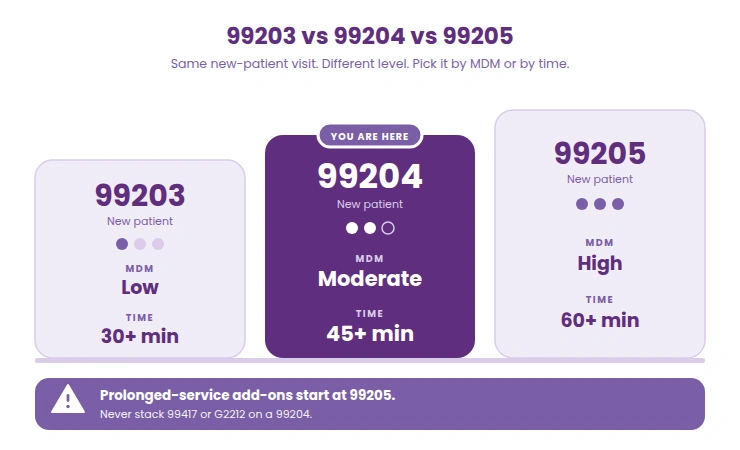
Moving from 99204 to 99205 is worth about $59 per visit at the national Medicare rate. A periodic medical billing and coding audit shows whether your claims lean toward undercoding or overcoding.
A trap worth knowing: prolonged-service add-ons don't attach to 99204. CPT's 99417 starts only after 99205's time is exceeded. Medicare doesn't accept 99417 at all and uses HCPCS G2212 instead, which starts at 89 minutes with 99205. If you spend 80 minutes on a new patient, you bill 99205 on time, not 99204 plus an add-on.
Does CPT Code 99204 Need a Modifier?
No. 99204 doesn't require a modifier on its own. Add one only when the situation calls for it:
- Modifier 25: a significant, separately identifiable E/M on the same day as a procedure. The documentation has to show the E/M stood apart from the usual pre-procedure work.
- Modifier 57: the visit resulted in the decision to perform major surgery (day before or day of).
- Modifier 95: synchronous audio-video telehealth, for payers that ask for it. Traditional Medicare generally doesn't require it for audio-video visits but does want the correct place of service.
- Modifier 93: audio-only visits for Medicare.
Check each commercial payer's policy.
Is There an Age Limit for CPT Code 99204?
No, 99204 has no age limit. The descriptor never mentions age. What matters is patient status.
A patient is "new" if they haven't received a professional service from you, or from another physician of the same specialty and subspecialty in the same group, within the past three years. A patient who saw a cardiologist in your group two years ago can still be new to an endocrinologist in that group.
A well-child checkup belongs under the preventive codes.
CPT Code 99204 Reimbursement
Medicare's 2026 national payment for CPT 99204 is set at $177.36 in a non-facility setting and $116.90 in a facility setting. The office figure is derived from 5.31 total RVUs multiplied by the 2026 conversion factor of $33.4009 for non-qualifying APM clinicians. For qualifying APM participants, the conversion factor is slightly higher at $33.5675.
Three things shape what you'll actually collect:
- Geography. Medicare multiplies each RVU component by a local GPCI, so your allowed amount can sit above or below the national figure.
- Site of service. CMS's 2026 practice expense changes pushed payment toward office-based settings, which is why the facility rate is lower.
- Payer. Medicaid and commercial rates are set separately from Medicare's, so check each contract.
The 2026 conversion factor includes a one-year 2.5% increase that's scheduled to expire at the end of 2026. Don't build 2027 projections on this year's rate without checking the new fee schedule.
If collections on 99204 come in below your contract rate, it may be an underpayment recovery problem rather than a coding one.
Is CPT Code 99204 Covered by Medicare?
Yes. Medicare Part B pays for 99204 when the patient is new to the practice, the visit is medically necessary, and the record supports the level billed.
Medicare telehealth flexibilities, including coverage for patients at home, were extended through December 31, 2027, so 99204 can currently be delivered by telehealth when the other rules are met. These extensions have been temporary before, so recheck the date before you schedule far ahead. Providers who see new patients by video also need the right enrollment in place, which is where telehealth credentialing comes in.
Medicare Advantage plans and Medicaid can add their own prior-authorization, network, and documentation rules. When a plan asks for approval before the visit or follow-up workup, prior authorization services keep the schedule from stalling.
What Gets 99204 Denied or Downcoded
Common causes:
- Patient status errors. The patient had a visit with your group's same specialty within three years.
- Time billed without a time statement. Say that you're selecting the level by time, state the total minutes, and describe what you did.
- Thin MDM. Listing "HTN, DM, hyperlipidemia" without any assessment of each leaves you with a problem list rather than moderate problems.
- Cloned notes. Copy-forward text invites an audit.
- Wrong add-on. 99417 on a Medicare claim, or any prolonged code stacked on 99204.
A short documentation check before you sign: new-patient status confirmed, level chosen by MDM or time (not both), time statement if time is used, and the prescription management or data reviewed spelled out.
When a 99204 claim does get denied, don't just resubmit it. Work the denial reason, fix the root cause, and appeal with the note attached. A dedicated denial management process fixes the root cause, and A/R recovery and follow-up catches claims that go unpaid.
Conclusion
Confirm the patient is truly new, pick the level by MDM or by time (never a blend), document the reasoning in plain words, and skip modifiers and add-ons unless the visit actually needs them. In 2026, a correctly supported 99204 pays $177.36 at the Medicare national non-facility rate.
If you'd rather not carry all of this yourself, HMS USA LLC supports practices with medical billing services, physician billing, and full revenue cycle management, so your new-patient visits are coded, submitted, and paid the way they should be.
Medical and Billing Disclaimer
This article on CPT code 99204 is for general educational purposes only and is not medical, legal, or coding advice. Rates are national estimates and rules change, so verify with the current CPT code book, CMS, and your payer before billing
FAQ! Need Help?
It's a new-patient office or outpatient E/M visit requiring moderate medical decision making or at least 45 minutes of total time on the date of the encounter.
At least 45 minutes of total provider time on the date of service. CPT no longer lists an upper limit; 60 minutes supports 99205.
No. Add modifier 25, 57, 95, or 93 only when the circumstances require it.
99203 requires low MDM or 30 minutes. 99204 requires moderate MDM or 45 minutes.
No. The code depends on new-patient status (no service from the same specialty and group in three years), not age.
Yes, under Part B when medically necessary and billed for a new patient. The 2026 national non-facility rate is $177.36.
No. Prolonged-service add-ons start with 99205, using 99417 for most payers or G2212 for Medicare.
ABOUT AUTHOR

Pedro Collins
As a blog writer with years of experience in the healthcare industry, I have got what it takes to write well-researched content that adds value for the audience. I am a curious individual by nature, driven by passion and I translate that into my writings. I aspire to be among the leading content writers in the world.