
A Good Faith Estimate (GFE) is a written estimate of what a provider expects to charge for scheduled care. Under the No Surprises Act, providers must give one to patients who are uninsured or who choose to pay without using insurance. It is due within 1 to 3 business days of scheduling, depending on how far ahead the visit is booked. If the final bill ends up $400 or more above the estimate, the patient can dispute it.
If you see self-pay patients, this is not a rule to improvise. Below you will find who qualifies, when the estimate is due, what goes on it, and how to build a process that does not depend on whoever happens to pick up the phone.
What is a Good Faith Estimate?
A Good Faith Estimate is a written breakdown of the healthcare charges a provider or facility reasonably expects to bill for scheduled or requested services. The requirement was introduced under the No Surprises Act, which took effect on January 1, 2022.
A GFE is not a bill. It gives patients an opportunity to review expected costs before receiving care and helps them understand what they may be required to pay.
The estimate should identify the planned services and their expected charges rather than provide only a single unexplained total. When a patient receives the final bill, they can compare it with the estimate to check whether the charges differ significantly.
Why it matters for medical billing
A documented estimate gives the scheduling and billing teams a reference point for communicating prices, reviewing discrepancies, and responding to patient questions about unexpected charges.
Who must get a Good Faith Estimate?
Uninsured patients, and insured patients who choose not to use their insurance for the visit.
The second group is the one practices forget. A patient who has coverage but pays your full fee and files their own claim for reimbursement is self-pay under the rule. That happens a lot with out-of-network care, and it still triggers an estimate.
Visits billed to a health plan do not need the self-pay estimate, and people covered by federal programs such as Medicare and Medicaid are generally outside this rule. The requirement itself reaches nearly every provider and facility, in network or out.
So the first question at scheduling decides everything: will insurance be billed for this visit? Asking it every single time is a front-desk habit more than a billing one, and it is usually the first thing that improves when a practice tightens its front office management.
When is a Good Faith Estimate due?
One or three business days after scheduling, or three business days after the patient asks for it. The one exception is a visit booked only 0 to 2 business days ahead, which does not require an estimate.
|
When the care is scheduled |
When the estimate is due |
|
0 to 2 business days ahead |
No estimate required |
|
3 to 9 business days ahead |
Within 1 business day of scheduling |
|
10 or more business days ahead |
Within 3 business days of scheduling |
|
Patient asks for a price before booking |
Within 3 business days of the request |
A quick example
A patient books a knee MRI on Monday for the Tuesday of the following week. That is 6 business days out, so the estimate is due by the end of the next business day.
Two things restart the clock. If the patient reschedules, a new estimate is due within the same timeframes. If anything on the estimate changes, such as the service, the provider, or an expected charge, send a new one no later than 1 business day before the visit.
The estimate has to be in writing, on paper or electronically, in whichever form the patient prefers. If they want to talk it through, you can also explain it by phone or in person.
What must a Good Faith Estimate include?
No single form is mandatory. CMS publishes a sample template that most practices start from, but the content is not optional. A compliant estimate lists:
- the patient's name and date of birth
- a plain-language description of the primary service, plus the scheduled date if there is one
- an itemized list of expected items and services with the expected charge for each, including facility fees where they apply
- the service and diagnosis codes
- the provider's name, NPI and TIN, and the state and location where care will be delivered
- a note on related services that will be scheduled separately and are not in the estimate
- the disclaimers: it is only an estimate, actual charges may differ, it is not a contract, and the patient may start a dispute if billed $400 or more above it
Use the codes your biller will use on the claim, so the estimate and the claim start from the same place. That is much easier when medical coding is handled consistently. And write for the patient, not the billing office: a bare CPT code with no description tells them nothing.
For ongoing care such as weekly therapy, one estimate can cover the whole course for up to 12 months. State the expected frequency, the number of visits and the charge per visit, then issue a fresh estimate before the 12 months run out.
An estimate may leave out services scheduled separately (a pre-surgery appointment, or physical therapy in the weeks after an operation), items provided by another provider or facility, and extra services you could not reasonably have anticipated.
Do co-provider charges have to be included?
On paper, yes. In practice, not yet. The law makes whoever receives the request, the convening provider, responsible for gathering expected charges from co-providers and co-facilities, such as the anesthesiologist or the surgery center. Since December 2022, HHS has used enforcement discretion for estimates that leave those charges out, pending future rulemaking. The related Advanced Explanation of Benefits (AEOB) process for insured patients is paused too.
So give a complete estimate for your own services and, where you can, add a range for the related care. For surgery, CMS tells patients to ask for separate estimates from the surgeon and the hospital. This is the part of the rule most likely to change.
What happens if the bill is $400 or more above the estimate?
The patient can start the patient-provider dispute resolution process. Here is how it works:
- The patient has 120 calendar days from the date of the initial bill to start it.
- They pay a non-refundable administrative fee, which was $25 when the process began and can change.
- They submit their copy of the estimate, the bill and the provider's contact details.
- An independent third party reviews the case.
Below $400 there is no formal dispute path, but small overruns still cost you trust. Most disputes begin with a statement the patient did not expect, so patient billing that mirrors the estimate line by line, and a quick correction when the gap is your error, does more than any policy document.
Skipping the estimate has its own consequence. A patient who should have received one can file a complaint with CMS.
How do you set up a Good Faith Estimate process?
Most problems are not about knowing the rule. They are about handoffs: someone takes a call, the quote stays in their head, and no estimate goes out. Build the handoffs in.
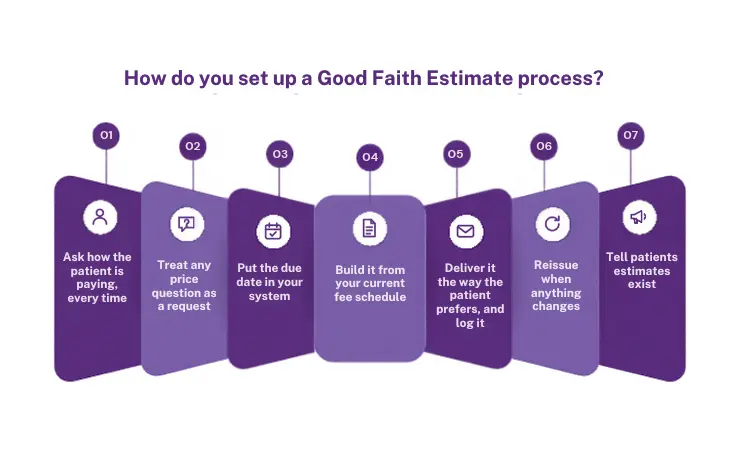
- Ask how the patient is paying, every time
If insurance will not be billed, flag the chart as self-pay or uninsured immediately. - Treat any price question as a request
A patient can ask for an estimate before booking, and you then have 3 business days. - Put the due date in your system
Count business days from the day of scheduling or the day of the request. - Build it from your current fee schedule
Use the rate the patient will actually pay, discounts included, not last year's price list. - Deliver it the way the patient prefers, and log it
Record the date and the method, and keep a copy in the patient's record. - Re-issue when anything changes
A new service, a new fee, a rescheduled visit, or a recurring estimate nearing its 12-month limit. - Tell patients estimates exist
Say so on your website and on-site where care is scheduled, and mention it whenever a patient asks about cost.
Name one person who owns the process. An estimate that belongs to "the front desk" tends to belong to nobody.
Once it is running, pull ten recent self-pay charts and check whether each had an estimate, on time, with every element. A medical billing and coding audit does exactly this and shows where the process leaks.
Which Good Faith Estimate mistakes cause the most trouble?
- Waiting for the patient to say "good faith estimate." Any request for a price counts.
- Forgetting the superbill patient. Insured, but paying you directly and claiming reimbursement themselves, still means self-pay.
- Letting fees drift. Raise a fee or add a service without re-issuing the estimate and you are one bill away from the $400 gap.
- Leaving things out. Missing NPI or TIN, missing disclaimers, or a service described only by a code.
- Writing "weekly, ongoing." State the number of visits, the charge per visit and a period of no more than 12 months.
How is a Good Faith Estimate different from an ABN, AEOB or superbill?
|
Document |
Who it is for |
Who issues it |
Purpose |
|
Good Faith Estimate |
Uninsured and self-pay patients |
Provider or facility |
Expected charges for scheduled care, before the visit |
|
ABN (Advance Beneficiary Notice) |
Original Medicare patients |
Provider |
Warns that Medicare may not cover a service; the patient signs and picks an option |
|
AEOB (Advanced Explanation of Benefits) |
Insured patients |
Health plan |
Compares the estimate with the in-network price; enforcement is on hold |
|
Superbill |
Patients who pay out of pocket and claim reimbursement |
Provider |
After-visit record the patient sends to their own plan; not an estimate |
Conclusion
A Good Faith Estimate is simple in principle: ask how the patient is paying, quote the real price in plain language, deliver it on time, and re-issue it when anything changes. When practices struggle, it is rarely because the law is confusing. It is because scheduling, billing and record keeping do not hand off to each other.
Fix the handoffs and the rule mostly takes care of itself. If you would rather not run it alone, our medical billing services cover self-pay patients from estimate to payment, and our team can review your current process and tighten it.
Last updated October 2026. This article is general information, not legal advice. Check current CMS guidance and your state rules before changing your policies
FAQ! Need Help?
No. It is not a contract, and the patient is not obliged to use the provider. It still matters, because a final bill $400 or more above it can be disputed.
Not the self-pay version, if their claim is going to their health plan. A separate version for insured patients, tied to the AEOB, exists in the law but is not being enforced yet.
An estimate for recurring care can cover up to 12 months. Issue a new one whenever the service, provider or expected charges change.
If care is scheduled 0 to 2 business days ahead, the patient is not entitled to an estimate, although they can still ask for one.
Ask the provider, who must respond within 3 business days if the patient asks before booking. Keep a copy or photo of whatever you receive, because you need it to dispute a bill. If you should have received one and did not, you can file a complaint with CMS, or call the No Surprises Help Desk at 1-800-985-3059.
ABOUT AUTHOR

Alex White
I’m Alex White, a Senior A/R Specialist with years of experience in medical billing and coding. I specialize in revenue cycle management and reimbursement processes, with a passion for accuracy and efficiency. Through my writing, I aim to share valuable insights and be a trusted voice in the medical billing and coding industry.